Jurassic World Rebirth (2025) — Read, Study & Download the Screenplay
Three samples. One forbidden island. And a rescue mission that keeps becoming more important than the job everyone was paid to do.
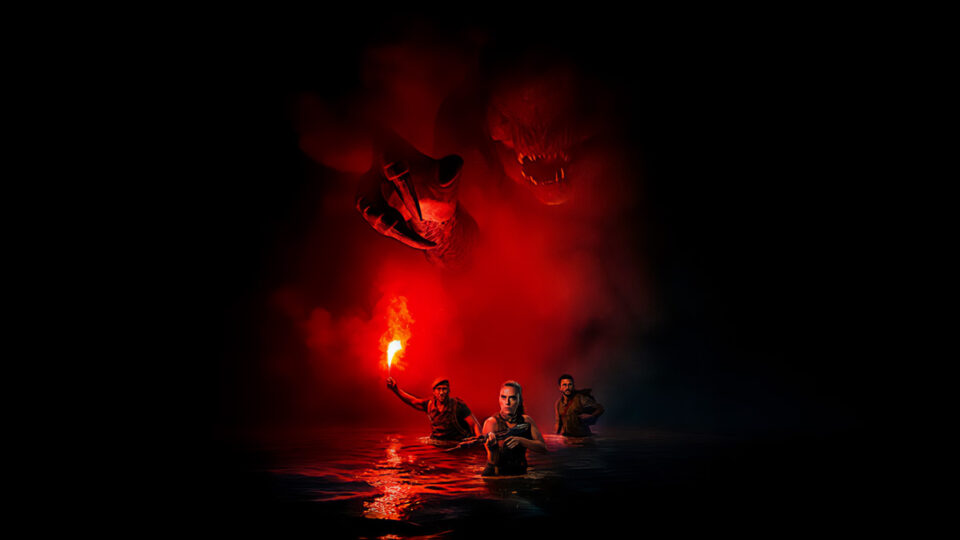
The Jurassic World Rebirth screenplay begins in a world that has almost moved on from dinosaurs. Most of the animals released into the modern ecosystem are dying out, public fascination has faded, and the surviving giants have retreated to a handful of equatorial environments where the climate still suits them. Into that world comes Zora Bennett, hired by pharmaceutical representative Martin Krebs to lead an illegal expedition with paleontologist Dr. Henry Loomis and boat captain Duncan Kincaid. Their objective is precise: obtain biological samples from the largest surviving marine, terrestrial, and flying prehistoric species, material that could lead to a breakthrough treatment for heart disease.
For writers and film students, David Koepp's screenplay is an excellent study in parallel storylines, escalating objectives, ensemble motivation, survival plotting, and moral choices embedded inside adventure. The expedition begins as a carefully defined extraction mission, while the stranded Delgado family simply wants to survive. As those stories move toward each other, professional goals become tangled with rescue, responsibility, scientific wonder, corporate greed, and the question of who should benefit from a discovery worth trillions. The dinosaurs provide the danger and spectacle, but the screenplay stays readable because every character enters the island wanting something different.
Ready to return to the Jurassic? Check out the Study Notes just below. Major story and ending spoilers ahead. When you're ready, download the Jurassic World Rebirth (2025) screenplay.
Jurassic World Rebirth Study Notes
What writers and film students can learn from this screenplay
Jurassic World Rebirth is useful to study because its large-scale adventure is built around several unusually clear objectives that keep changing value as the story progresses. Zora's team enters the forbidden zone to collect three biological samples. The Delgado family enters the story with a much simpler goal: survive and get home. Once the expedition loses its boat and people begin dying, those objectives overlap with rescue, reaching the abandoned facility before extraction disappears, escaping the island, and deciding what should happen to the samples if anyone survives. The screenplay grows larger without becoming shapeless because every new complication either changes the objective, adds another responsibility, or forces a character to decide which goal matters most.
Craft Focus
- A mission designed in three parts: Mosasaurus, Titanosaurus, and Quetzalcoatlus give the expedition an immediately understandable progression. Each sample becomes its own dramatic problem with a different environment, physical challenge, and form of danger.
- Parallel stories with a planned collision: Zora's expedition and the Delgado family's survival journey initially operate independently. Cutting between them creates variety while allowing each group to develop its own relationships, skills, and problems before both storylines finally converge at the abandoned facility.
- Different motivations inside one objective: Zora wants enough money to leave dangerous work behind. Loomis wants discovery and scientific purpose. Krebs wants proprietary value. Kincaid wants money but increasingly feels responsible for the stranded family. Because they share a destination without sharing a reason, conflict can emerge naturally without stopping the adventure.
- Escalation by adding responsibilities: After the boat is lost, the screenplay does not simply make the original mission harder. The characters must recover the remaining samples, search for survivors, reach the extraction point before a deadline, and stay alive. The story expands by stacking obligations onto the same journey.
- Let wonder and danger coexist: Loomis continually sees scientific meaning in the animals even when everyone else sees immediate danger. That perspective helps the dinosaurs remain animals rather than interchangeable monsters and preserves the sense of awe that gives the franchise its emotional identity.
- Turn the MacGuffin into a moral choice: The sample case begins as something the characters are paid to obtain. Gradually Loomis raises a different question: if those samples can create medicine capable of saving millions of lives, should any corporation own the result? By the ending, possession of the samples matters less than what Zora chooses to do with them.
Questions for Writers
- Why does the screenplay begin by showing a world that has become bored with dinosaurs? How does that choice allow the expedition to rediscover their wonder?
- What does the three-sample structure give the audience that a more general objective such as "collect dinosaur DNA" would not?
- How does cutting between the expedition and the Delgado family affect pacing before the two groups finally meet?
- At what point does rescuing the stranded family become part of the expedition's mission? Which characters embrace that responsibility first, and which resist it?
- How does Zora's stated desire for money evolve without requiring her to suddenly become a completely different person?
- Why is Loomis useful as more than the screenplay's source of dinosaur information? How does his ethical position gradually influence Zora?
- How does Krebs's behavior turn the pharmaceutical mission from a morally complicated proposition into a more direct conflict over ownership and human life?
- Why does the screenplay bring both groups together before the final Distortus rex sequence rather than allowing the expedition and family stories to resolve separately?
- What does Kincaid's decision to draw Distortus away from the others reveal about the difference between the reasons he joined the mission and the person he has become by the climax?
- Why is Zora's final decision about the samples a stronger resolution than simply surviving with them?
While reading, track the screenplay through objective, complication, convergence, choice, consequence. Start each major sequence by identifying what the characters believe they need to accomplish. Then notice how the danger adds another obligation rather than merely delaying them. Watch especially for the point where the two separate survival stories become one and where characters begin choosing people over the narrower terms of the mission. By the final act, the sample case, the stranded family, the extraction plan, and the island's experimental creatures are all occupying the same dramatic space. Jurassic World Rebirth is a useful example of how a large adventure screenplay can keep expanding its stakes while preserving a clear chain of objectives the audience can follow.
Looking for the screenplay? Jump to the download button.
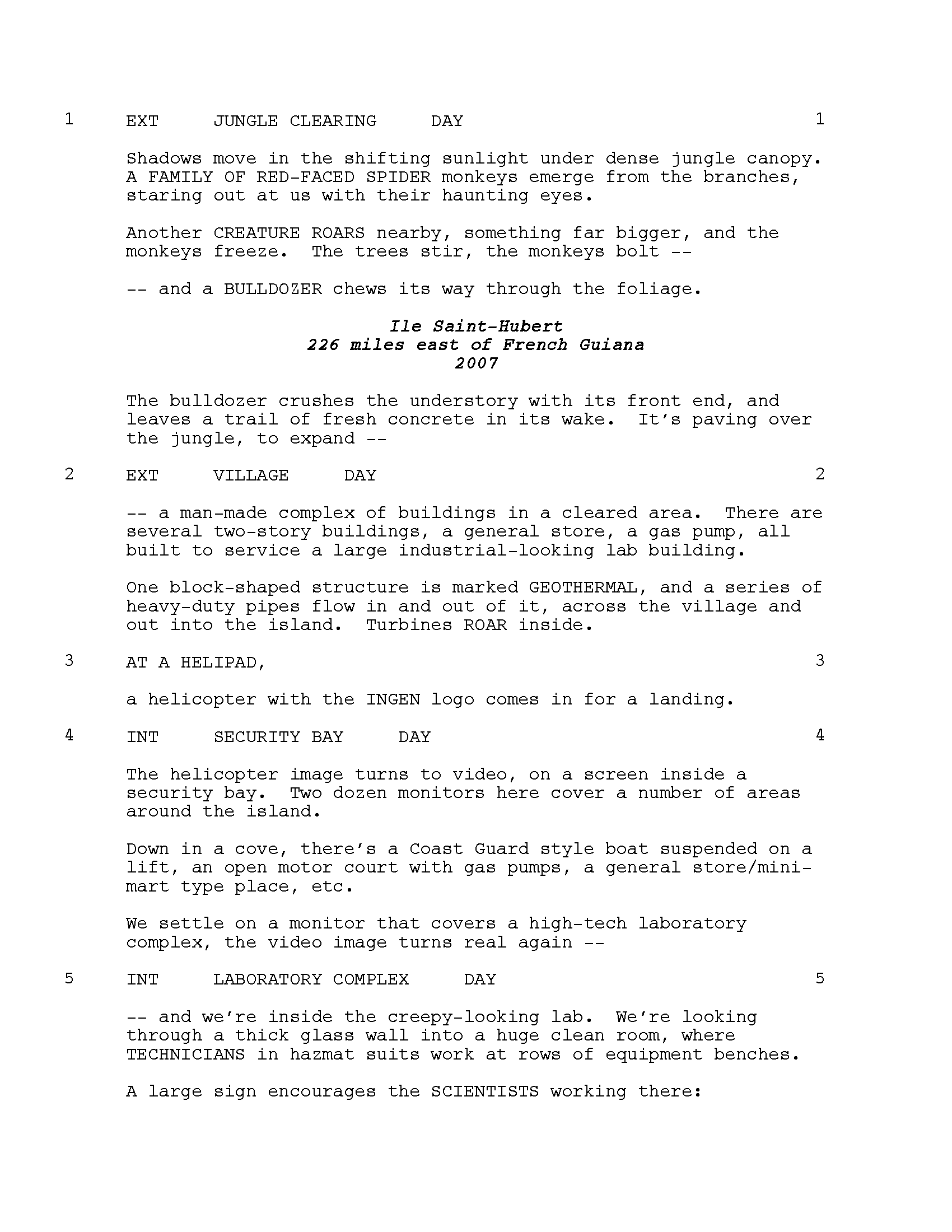
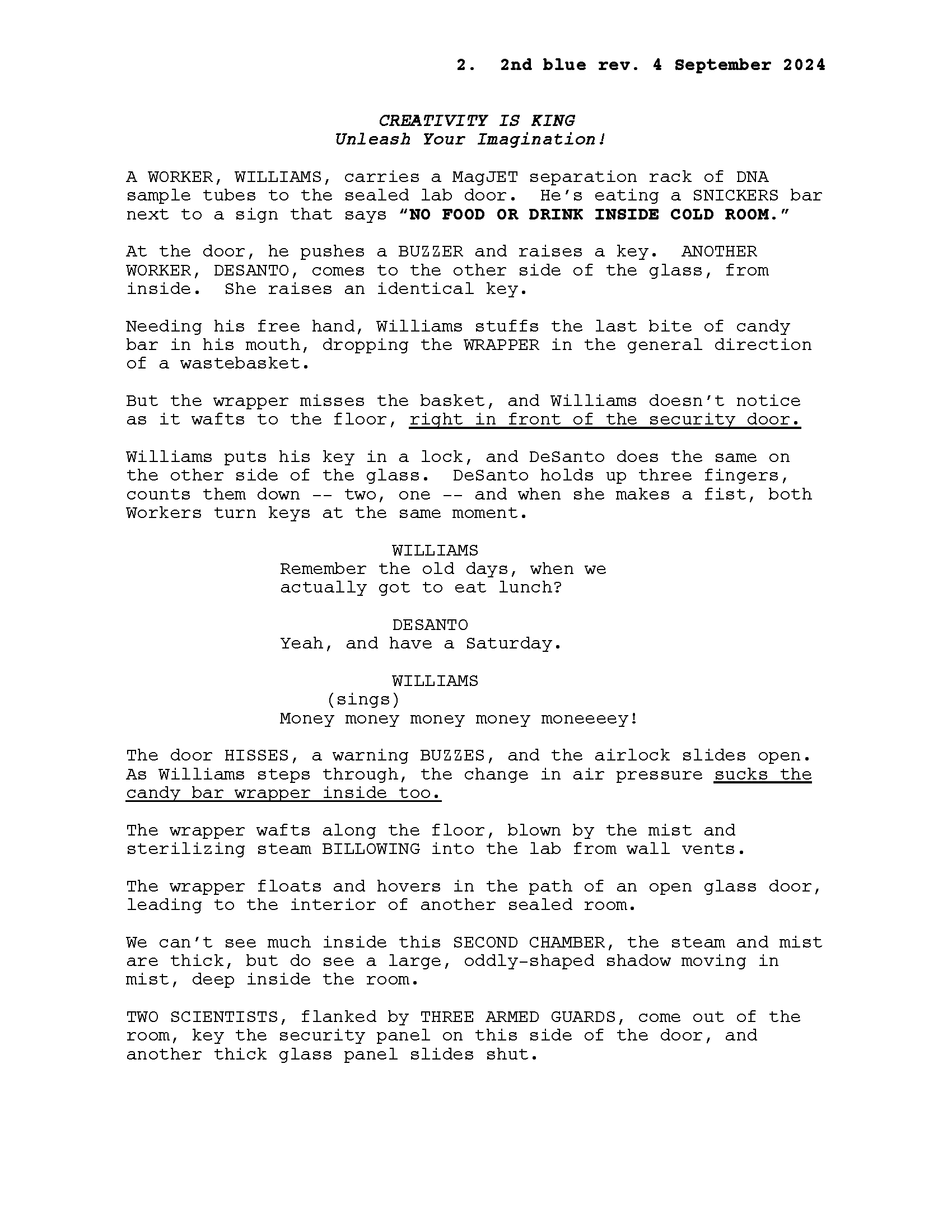
Jurassic World: Rebirth (2025)
Five years post-Jurassic World: Dominion, an expedition braves isolated equatorial regions to extract DNA from three massive prehistoric creatures for a groundbreaking medical breakthrough.
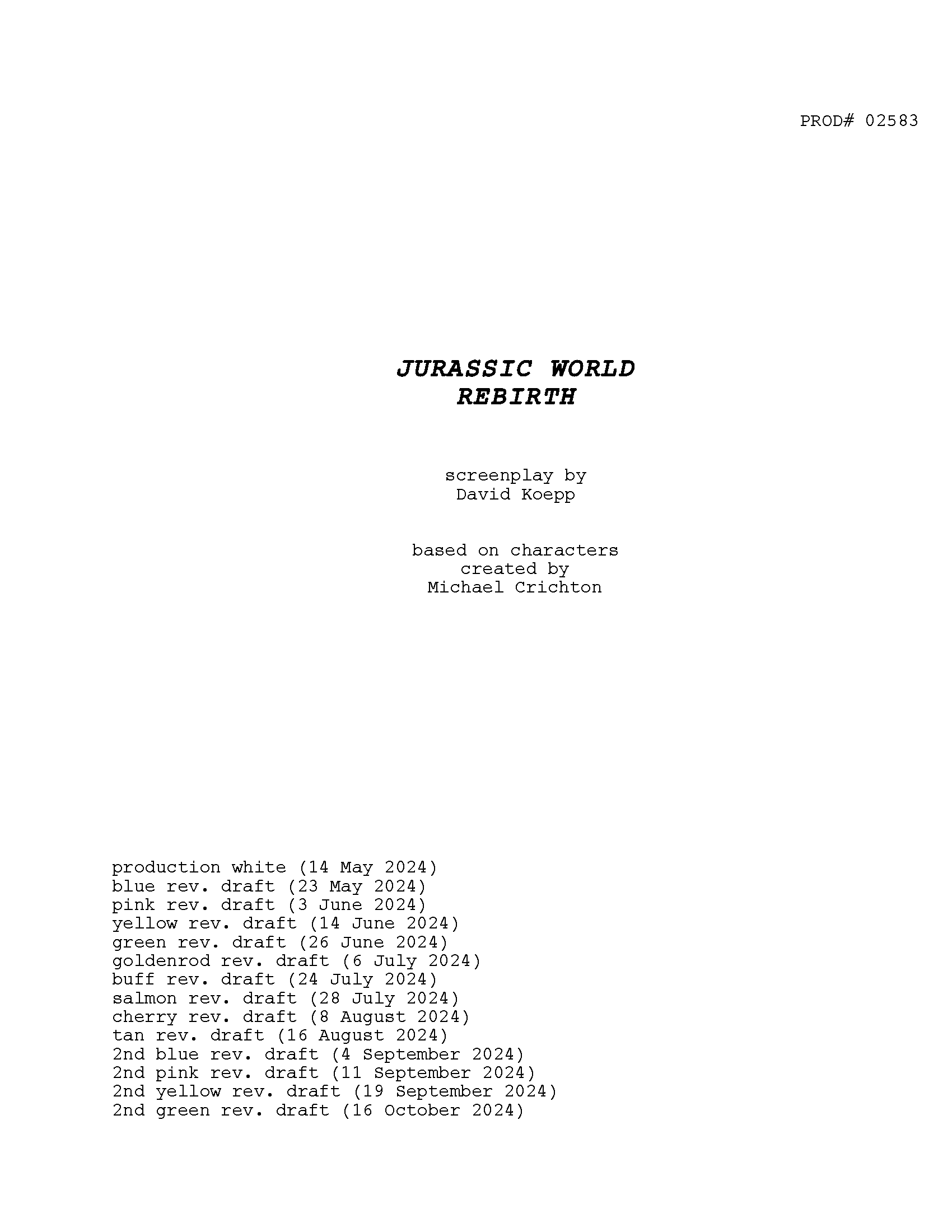
Screenplay download
Reading is open to everyone. A free account is only required to download so we can protect the library and respect rights-holder requests. Already registered? Log in and you’re set.
Read and Watch
Compare the script and movie together with 8FLiX and JustWatch.
Now that you have the screenplay, stream Jurassic World: Rebirth and compare. We've partnered with JustWatch so you can make that happen.
Looking For Something?
If you can't find what you need, send us an email.
Looking for a specific movie or TV script that isn't listed? Let us know. 8FLiX has thousands of scripts, and not all of them are indexed yet. We’re steadily adding more, but if you’d rather not wait for the catalog to catch up, send us an email. You may still have to wait, but it’ll usually be days, not geological time.