Memento (2000) — Read, Study & Download the Screenplay
A reverse-engineered neo-noir about memory, grief, revenge, self-deception, and a man using tattoos and Polaroids to hunt a truth he may not want to find.
The Memento screenplay follows Leonard Shelby, a former insurance investigator with anterograde amnesia, meaning he can remember his life before the attack that killed his wife, but cannot form new memories afterward. To survive, Leonard builds a system from Polaroids, handwritten notes, tattoos, motel rooms, routines, and “facts,” all pointed toward one goal: find and kill the man he believes raped and murdered his wife. But every clue in Leonard’s world is only as reliable as the person who wrote it, and the most dangerous person writing Leonard’s story may be Leonard himself.
For writers and film students, Christopher Nolan’s screenplay is essential because it turns form into psychology. Study how the color sequences move backward, the black-and-white sequences move forward, and the two timelines slowly crush together until the audience experiences Leonard’s condition as structure rather than exposition. It is noir built from missing minutes, motel keys, fake certainty, burned photographs, manipulated grief, and one terrible question: if memory is unreliable, what happens when “facts” become just another kind of fiction?
Ready to get to work? Check out the Study Notes just below. When you're ready, download the Memento screenplay.
Memento Study Notes
What writers and film students can learn from this screenplay
The Memento screenplay is useful to study because it makes structure indistinguishable from character. Christopher Nolan opens with a Polaroid image fading instead of developing, a murder moving backward, and a protagonist whose life depends on evidence he cannot remember collecting. Leonard Shelby insists that memory is unreliable and facts are dependable, but the screenplay keeps attacking that certainty from every angle. Polaroids can be captioned. Notes can be planted. Tattoos can preserve errors as commandments. Natalie can exploit him. Teddy can tell the truth and still sound like a liar. Even Sammy Jankis, Leonard’s favorite cautionary tale, becomes unstable as the story approaches its terrible center. The genius is that the audience does not merely watch Leonard’s confusion. The screenplay turns us into investigators trapped inside his method.
Craft Focus
- Form as empathy: The reverse color timeline forces the audience to enter each scene without knowing what just happened, closely mirroring Leonard’s experience of waking into consequences.
- Dual timeline mechanics: The black-and-white motel-room thread moves forward while the color thread moves backward. Their eventual collision creates both plot revelation and structural satisfaction.
- Objects as unreliable evidence: Polaroids, tattoos, motel keys, notes, envelopes, license records, and handwritten instructions all appear factual, but the script keeps asking who created them and why.
- Revenge as self-maintenance: Leonard’s hunt for John G. is not only a mission. It is the identity system that lets him keep functioning. Without the quest, he may have no self left to inhabit.
- Noir manipulation: Natalie and Teddy both use Leonard’s condition, but the script refuses easy moral sorting. The victim can manipulate. The liar can reveal truth. The detective can become his own cover-up.
Questions for Writers
- How does the opening reverse Polaroid image teach the audience the screenplay’s central grammar before the plot begins?
- Why is Leonard’s belief in “facts, not memories” so dramatically powerful, and so dangerous?
- How does the Sammy Jankis story help Leonard explain himself while also hiding something from himself?
- Where does the reverse chronology create irony, especially when the audience learns the cause after seeing the effect?
- How do Natalie and Teddy each exploit Leonard differently, and why does Leonard remain partly responsible for what he chooses to believe?
- Why does the ending land as both revelation and trap, rather than a simple twist?
While reading, pay attention to how Memento turns every storytelling tool into evidence and every piece of evidence into storytelling. A Polaroid is a memory substitute, but also a captioned lie. A tattoo is permanent, but only as honest as the moment that created it. A flashback feels explanatory until the script makes explanation itself suspect. That is the craft lesson in Leonard’s motel room: nonlinear structure works best when it is not decorative. Here, time is the crime scene, and the audience has to dust for prints with the lights going out every ten minutes.
Looking for the screenplay? Jump to the download button.
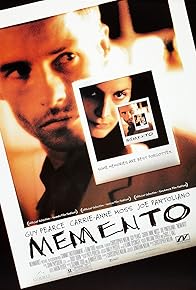
Memento (2000)
A former insurance investigator who now suffers from anterograde amnesia uses notes and tattoos to hunt down his wife's murderer.
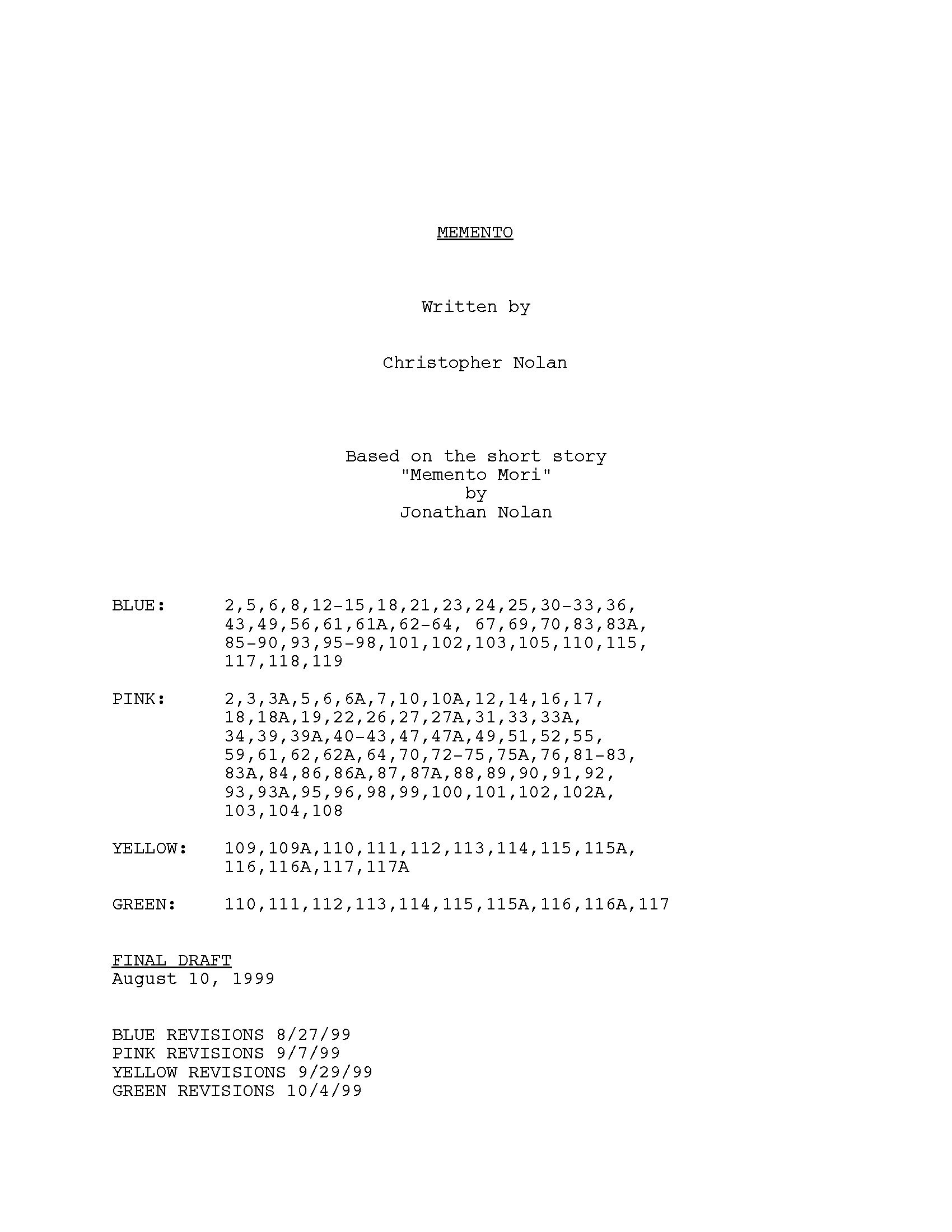
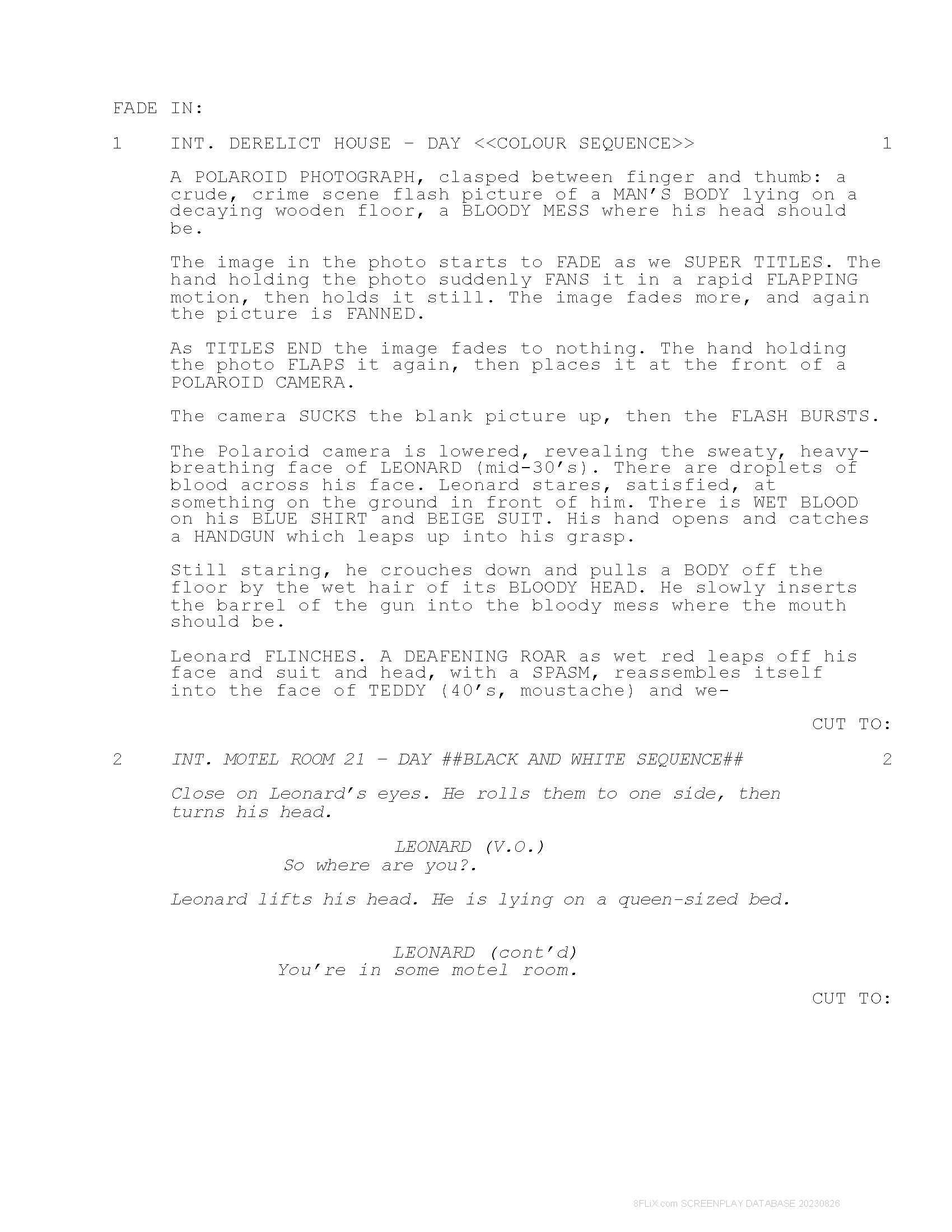
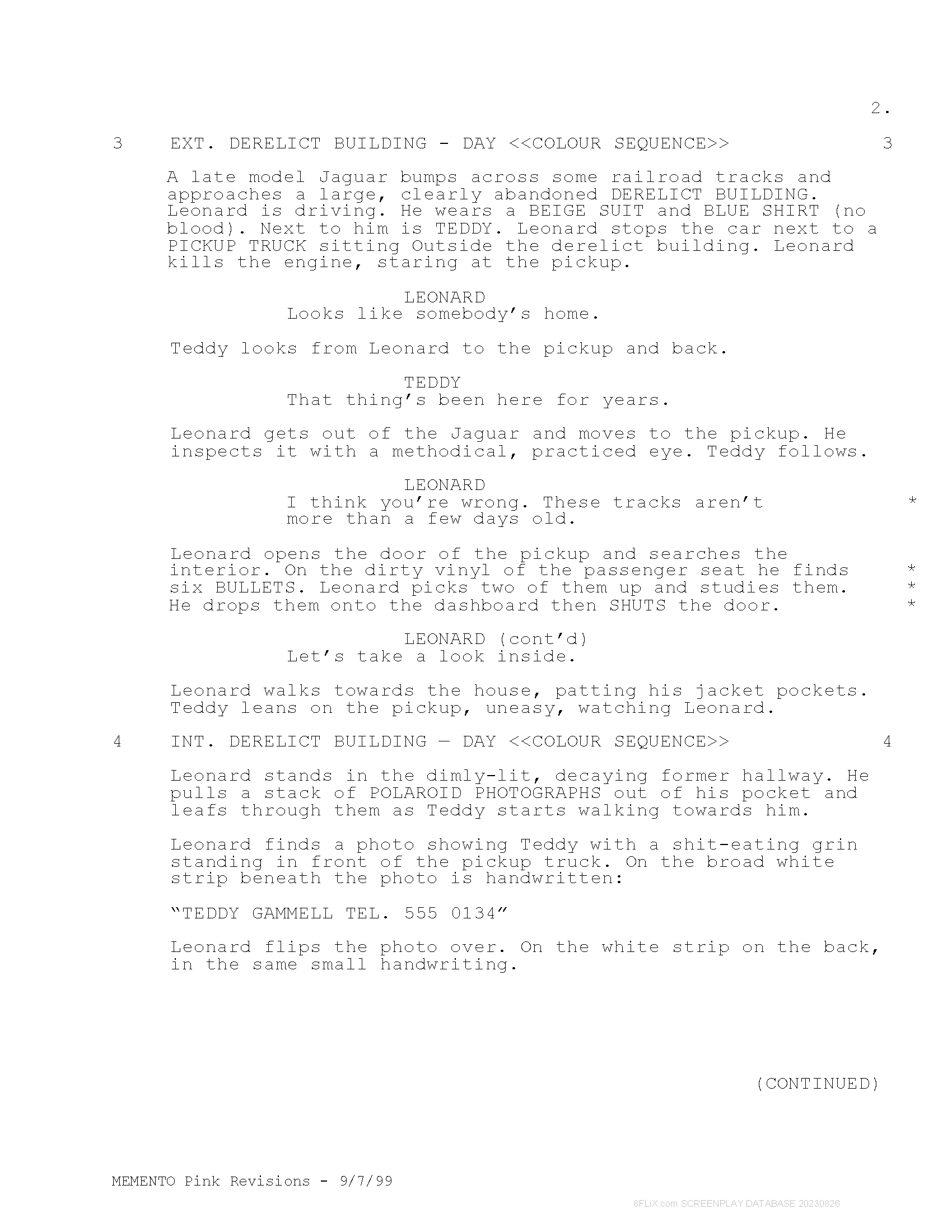
Screenplay download
Reading is open to everyone. A free account is only required to download so we can protect the library and respect rights-holder requests. Already registered? Log in and you’re set.
Read and Watch
Compare the script and movie together with 8FLiX and JustWatch.
Now that you have the screenplay, stream Memento and compare. We've partnered with JustWatch so you can make that happen.
Looking For Something?
If you can't find what you need, send us an email.
Looking for a specific movie or TV script that isn't listed? Let us know. 8FLiX has thousands of scripts, and not all of them are indexed yet. We’re steadily adding more, but if you’d rather not wait for the catalog to catch up, send us an email. You may still have to wait, but it’ll usually be days, not geological time.