Indiana Jones and the Kingdom of the Crystal Skull (2008) — Read, Study & Download the Screenplay
A lost-draft versus final-film study about crystal skulls, Cold War paranoia, Marion Ravenwood, legacy storytelling, and the Indy sequel that might have changed everything.
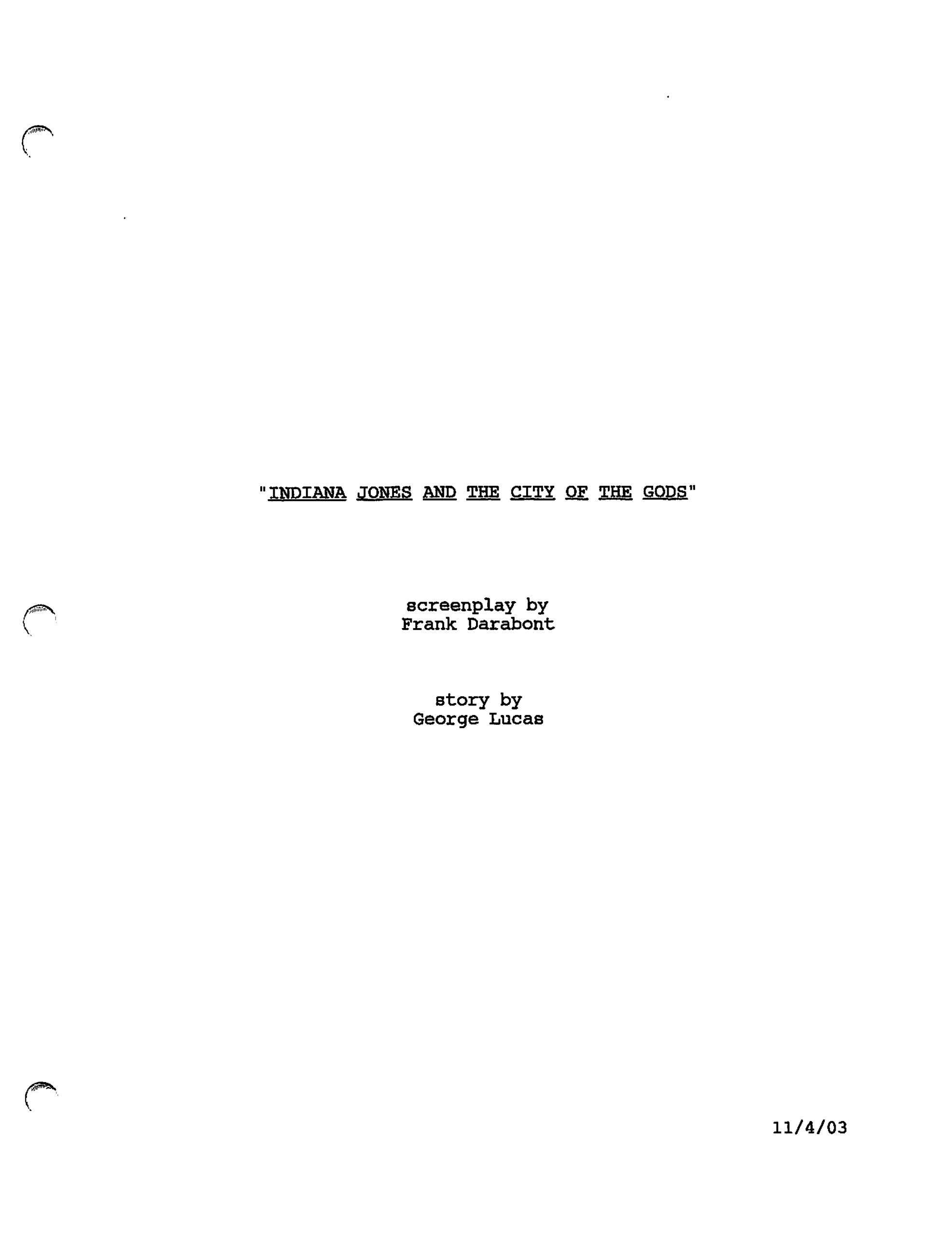
Indiana Jones and the City of the Gods, Frank Darabont’s November 4, 2003 draft, and Indiana Jones and the Kingdom of the Crystal Skull, David Koepp’s October 2007 final shooting script, share the same buried engine: an older Indy in the 1950s, Cold War enemies, a crystal skull, Nevada military secrets, Peru, a lost city, Marion Ravenwood, and an otherworldly finale that pushes the franchise from 1930s adventure serial into 1950s science-fiction pulp. Both versions are chasing the same glowing artifact. The difference is what each script believes the artifact should do to Indiana Jones.
Darabont’s City of the Gods leans harder into a bruised romantic adventure: Indy is aging, skeptical, semi-retired, pulled back into the game by betrayal, Marion, psychic warfare, and the mystery of the Lost City. Koepp’s Crystal Skull reshapes the same material into a legacy sequel: Mutt Williams becomes Indy and Marion’s son, Mac becomes the slippery friend-traitor, Spalko becomes the Soviet face of psychic obsession, and the ending pivots toward family restoration, marriage, and inheritance. Darabont gives Indy a choice at the climax. Koepp gives Indy a bloodline.
Let's discuss: City of the Gods v. Kingdom of the Crystal Skull.
For writers and film students, this draft comparison is pure cause-and-effect candy. Did Lucas’ decision to move away from Darabont’s version preserve the 1950s sci-fi MacGuffin he wanted, or did it also shift the franchise from romantic closure into legacy mechanics? Did adding Mutt modernize Indy for a new generation, or did it pull focus from the older hero’s own unfinished business with Marion, history, and belief? This is the “what could have been” page: two scripts, one skull, and a fork in the jungle path where adventure still had a name, but maybe not the same destination.
Indiana Jones IV Draft Comparison Study Notes
What writers and film students can learn by comparing City of the Gods and Kingdom of the Crystal Skull
Comparing Indiana Jones and the City of the Gods with Indiana Jones and the Kingdom of the Crystal Skull is useful because the two scripts reveal how much a rewrite can change without changing the basic expedition map. Both versions use a 1950s setting, Cold War anxiety, Russian or Soviet pursuit, a crystal skull, psychic power, Area 51-style secrecy, Peru, an ancient city, and Marion Ravenwood. But the dramatic emphasis shifts sharply. Darabont’s draft treats Indy as an older adventurer drawn back into a dangerous romance, a Cold War double-cross, and a mystery that asks whether knowledge should be possessed, weaponized, or destroyed. Koepp’s final shooting script turns the same premise into a legacy story, adding Mutt Williams as Indy’s son and using the skull quest to reunite a broken family. One version asks whether Indy still belongs in the adventure. The other asks whether the adventure can produce an heir.
Craft Focus
- Same skeleton, different heartbeat: Both drafts include the crystal skull, Cold War antagonists, Nevada military material, Peru, Marion, Oxley-style madness, and a lost city finale. The difference is where the emotional voltage goes.
- Darabont’s romantic adventure: City of the Gods gives Marion more central dramatic weight from the start. The rekindled Indy-Marion relationship is not a late reveal. It is part of the engine pulling Indy back into the myth.
- Koepp’s legacy machine: Crystal Skull introduces Mutt, the father-son reveal, Mac’s repeated betrayal, and Spalko’s psychic Soviet ambition. The result is broader, busier, and more explicitly about inheritance.
- Climax as thesis: Darabont lets Indy shoot the crystal skull, rejecting its power before it can be controlled. Koepp’s final version has the skull returned, the beings restored, and the city erased into interdimensional mystery.
- Cause and effect in rewriting: The rewrite does not simply swap scenes. It changes the franchise question from “Can Indy still choose the right thing?” to “Can Indy become husband, father, and old hero at the same time?”
Questions for Writers & Fans
- Does Darabont’s version feel more like a fourth Indiana Jones movie because it keeps Indy and Marion at the emotional center?
- Does Koepp’s version solve the “older Indy” problem better by giving him a son, a family reveal, and a generational mirror?
- Is the alien/interdimensional premise the real issue, or is the issue how clearly the story connects that premise to Indy’s inner life?
- Would the franchise have felt less like a legacy handoff if City of the Gods had been filmed instead?
- Does Mutt add necessary 1950s youth energy, or does he reroute the movie away from Indy’s own late-life arc?
- What happens to audience trust when a sequel asks viewers to accept both archaeological mysticism and science-fiction mythology in the same breath?
While reading both drafts, do not stop at “which one is better?” That is the easy campfire argument. The richer craft question is: which version creates the cleaner chain of cause and effect? Darabont’s draft argues that the crystal skull is dangerous because power tempts governments, traitors, scientists, romantics, and adventurers alike. Koepp’s final version argues that the skull quest forces Indy into a new family identity while the Cold War world hunts for weaponized knowledge. Those are different movies wearing the same hat. One burns with “what could have been.” The other became the official bridge to the franchise’s legacy era.
Looking for the screenplays? Jump to the download buttons.
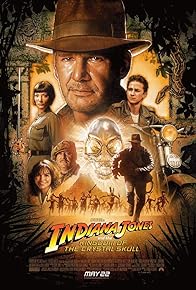
Indiana Jones and the Kingdom of the Crystal Skull (2008)
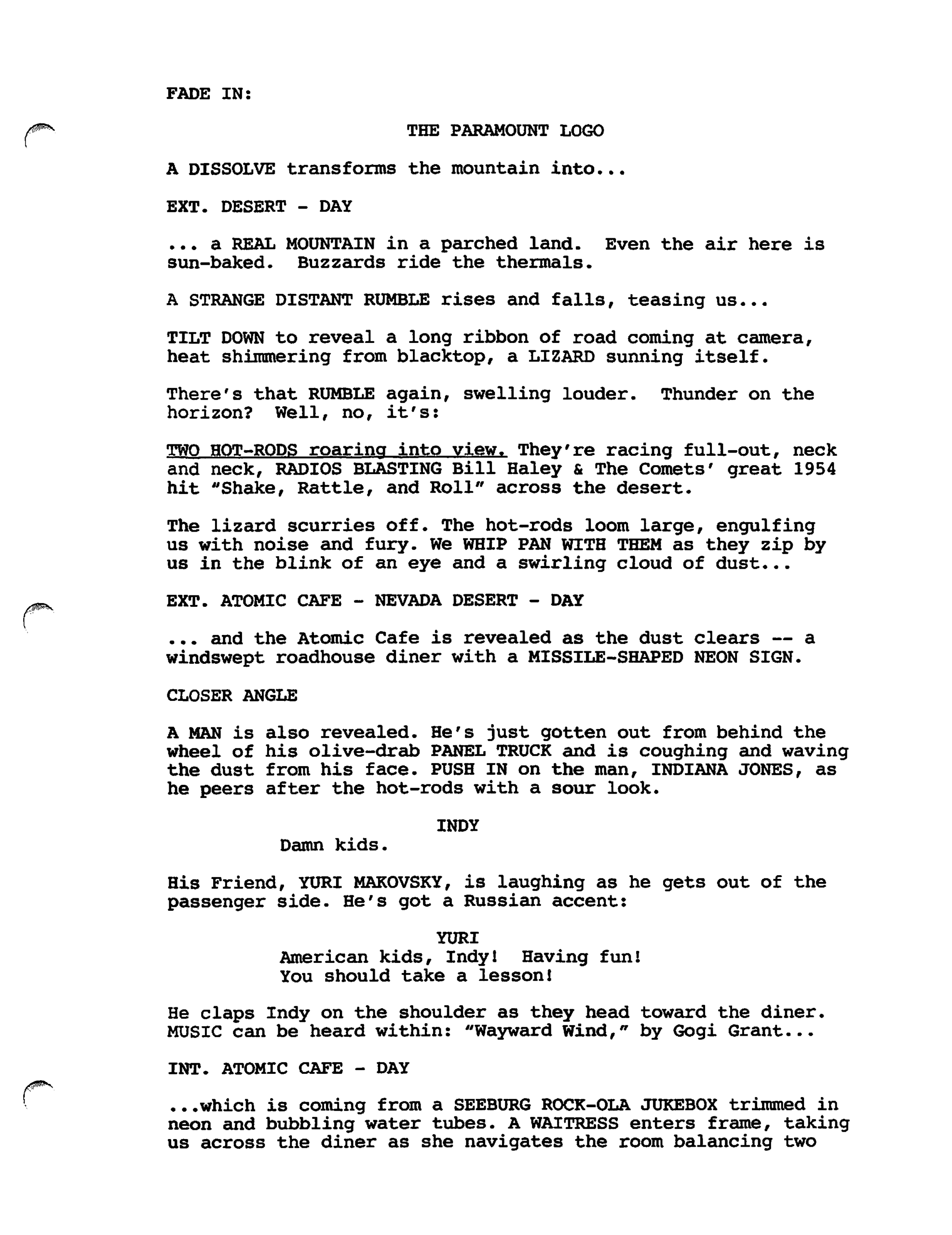
Frank Darabont's Indiana Jones and the City of the Gods. The 1st draft of what eventually became Indiana Jones and the Kingdom of the Crystal Skull, written by David Koepp.
Screenplay download
Reading is open to everyone. A free account is only required to download so we can protect the library and respect rights-holder requests. Already registered? Log in and you’re set.
Read and Watch
Compare the script and movie together with 8FLiX and JustWatch.
Now that you have the screenplay, stream Indiana Jones and the Kingdom of the Crystal Skull and compare. We've partnered with JustWatch so you can make that happen.
Looking For Something?
If you can't find what you need, send us an email.
Looking for a specific movie or TV script that isn't listed? Let us know. 8FLiX has thousands of scripts, and not all of them are indexed yet. We’re steadily adding more, but if you’d rather not wait for the catalog to catch up, send us an email. You may still have to wait, but it’ll usually be days, not geological time.