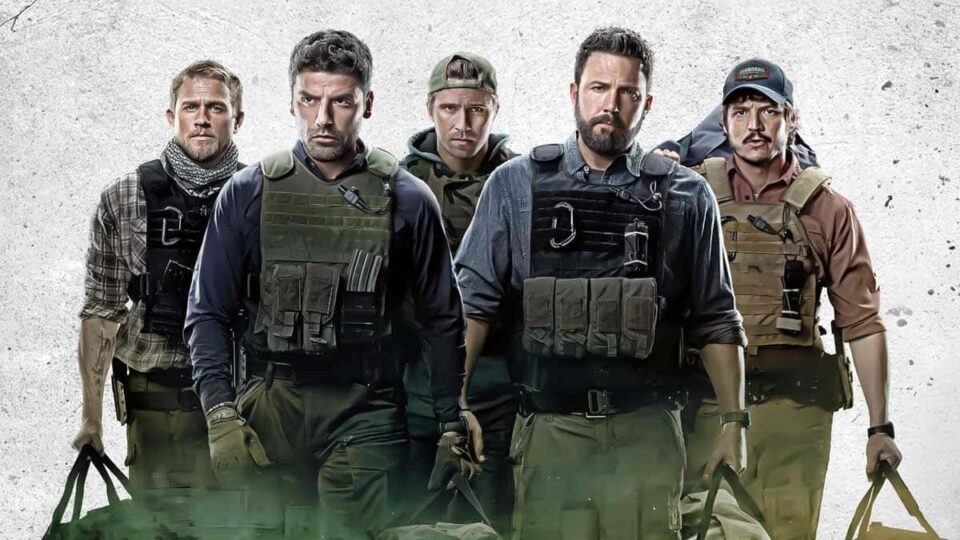
Triple Frontier (2019) — Read, Study & Download the Screenplay
A hard-edged military heist thriller about veterans, moral injury, cartel money, and the moment a mission becomes an excuse.
This Triple Frontier screenplay (Mark Boal's 1st draft) follows a group of former Special Forces operators pulled back into the orbit of Tom “Redfly” Davis and a dangerous plan to rob a South American drug lord named Lorea. What begins as surveillance and private-security work in the lawless borderlands of Paraguay, Argentina, and Brazil becomes a full-scale assault on a fortified mansion, where old skills, old loyalties, and old grievances are repurposed for one last score. The men tell themselves the target deserves it. The money, of course, tells a louder story.
For writers and film students, Mark Boal’s original draft is useful because it treats the heist less as fantasy and more as a pressure test for men who no longer know where their war ends. Study how the screenplay builds from favela violence, veteran disappointment, family strain, operational planning, border-zone surveillance, and cartel logistics into a mission where every tactical success creates a moral complication. This is not a clean “one last job” thriller. It is a story about competence curdling into entitlement, and about trained men discovering that the hardest thing to carry out of the jungle may not be the cash.
Triple Frontier Study Notes
What writers and film students can learn from this screenplay
Okay, so this Triple Frontier screenplay is useful to study because Mark Boal’s original draft turns a military heist into a slow moral landslide. The screenplay opens in Rio with Pope embedded in a brutal police operation, already operating in a world where legality, violence, cartel money, and American influence blur into one another. From there, the story relocates to North Carolina, where former operators like Redfly, Catfish, Ironhead, and Ben are not introduced as action heroes waiting for glory, but as men living with debt, divorce, dead-end work, damaged pride, and the afterlife of professional violence. That is the draft’s strongest engine. The heist does not emerge from pure greed. It emerges from resentment, justification, and the seductive logic of men who believe their skill has been underpaid by the country that used it. Once Lorea’s mansion becomes the objective, Boal’s writing keeps the mission procedural: surveillance, guards, cameras, terrain, timing, dry runs, infiltration routes, money weight, extraction risk. But every tactical detail carries a moral shadow. The team can get in. The harder question is whether they can get out without becoming the thing they claim to be punishing.
Craft Focus
- Heist as moral test: The robbery is not just a plot device. It exposes what each man believes he is owed, what he can rationalize, and where loyalty begins to crack.
- Veteran dislocation: The North Carolina scenes ground the action in civilian disappointment: stalled careers, family pressure, money stress, old authority, and a life after war that feels smaller than the men expected.
- Procedural realism: The draft pays attention to surveillance, guard routines, terrain, weapons, extraction timing, cash weight, and the logistical consequences of taking more than the plan can bear.
- Character through competence: Pope, Redfly, Catfish, Ironhead, and Ben are defined by how they assess risk, read space, challenge authority, or surrender to momentum.
- Geography as pressure: Rio, Booneville, Ciudad del Este, Lorea’s mansion, the river, the jungle, and the mountains each change the story’s rules, turning location into escalation.
- Money as antagonist: The cash is not passive loot. It changes decisions, slows movement, increases danger, and keeps asking the characters how much of themselves they are willing to trade for it.
Questions for Writers
- How does the Rio opening establish Pope’s fluency in violence, corruption, and compromised alliances before the heist plot begins?
- Why does the screenplay spend time with Redfly’s family life, retirement anxieties, and money pressure before presenting the job?
- How does Pope sell the operation by reframing theft as justice, punishment, or redistribution?
- Where does the draft make tactical competence feel exciting while still letting the audience sense the moral trap underneath?
- How do the mansion surveillance scenes turn architecture, guards, cameras, fences, and routines into story suspense?
- Why does the weight and volume of the money matter dramatically, not just practically?
- How does the script use the team’s military training as both their greatest advantage and the source of their worst decisions?
While reading, pay attention to how Triple Frontier keeps changing the meaning of the word “mission.” At first, the men treat the job like a clean operation: identify the target, plan the breach, neutralize obstacles, extract the package. But the package is money, the target is not a battlefield objective, and the rules are being written by need, pride, and old brotherhood. That is the craft lesson buried under the cash bricks: a thriller becomes richer when the external goal is simple, but every step toward it makes the characters less certain they can still describe themselves honestly.
Looking for the screenplay? Jump to the download button.
Triple Frontier (2019)
A group of former Special Forces operatives reunite to plan a heist in a sparsely populated multi-border zone of South America. This is Mark Boal's version from 2010.
![PREVIEW: Triple Frontier (2019) [MARK BOAL] screenplay - Page 1](https://8flix.com/wp-content/uploads/2026/06/Triple-Frontier-2019-MARK-BOAL-10.13.2010_Page_1-scaled.png "PREVIEW: Triple Frontier (2019) [MARK BOAL] screenplay - Page 1")
![PREVIEW: Triple Frontier (2019) [MARK BOAL] screenplay - Page 2](https://8flix.com/wp-content/uploads/2026/06/Triple-Frontier-2019-MARK-BOAL-10.13.2010_Page_2-scaled.png "PREVIEW: Triple Frontier (2019) [MARK BOAL] screenplay - Page 2")
![PREVIEW: Triple Frontier (2019) [MARK BOAL] screenplay - Page 3](https://8flix.com/wp-content/uploads/2026/06/Triple-Frontier-2019-MARK-BOAL-10.13.2010_Page_3-scaled.png "PREVIEW: Triple Frontier (2019) [MARK BOAL] screenplay - Page 3")
Screenplay download
Reading is open to everyone. A free account is only required to download so we can protect the library and respect rights-holder requests. Already registered? Log in and you’re set.
Read and Watch
Compare the script and movie together with 8FLiX and JustWatch.
Now that you have the screenplay, stream Triple Frontier and compare. We've partnered with JustWatch so you can make that happen.
Looking For Something?
If you can't find what you need, send us an email.
Looking for a specific movie or TV script that isn't listed? Let us know. 8FLiX has thousands of scripts, and not all of them are indexed yet. We’re steadily adding more, but if you’d rather not wait for the catalog to catch up, send us an email. You may still have to wait, but it’ll usually be days, not geological time.