22 Jump Street (2014) — Read, Study & Download the Screenplay
A self-aware college comedy sequel about friendship, repetition, arrested development, and two undercover cops discovering that “doing the same thing again” is not a life plan.
22 Jump Street sends Schmidt and Jenko across the street, literally, into a bigger-budget reboot of their own undercover lives. After a botched exotic-bird sting proves that their partnership may be creaking under the weight of success, the department orders them to repeat the formula: same identities, same assignment, same basic nonsense, only this time at MC State. Their mission is to infiltrate the dealer, find the supplier, and stop a new campus drug called WhyPhy before it spreads beyond college walls.
For writers and film students, this draft is useful because it turns sequel anxiety into structure. The screenplay knows it is repeating the first movie, then makes that repetition the joke, the plot, and the emotional problem. Study how the script uses college freedom, frat culture, football, new friendships, romantic complications, mirrored set pieces, and Schmidt and Jenko’s partnership drift to explore what happens when a buddy-cop duo starts behaving like a couple that needs therapy but got a bigger office instead.
22 Jump Street Study Notes
What writers and film students can learn from this screenplay
22 Jump Street is useful to study because it makes the sequel problem the story problem. Oren Uziel’s draft opens by recapping the first movie with open contempt for recap culture, franchise repetition, and the fact that everyone involved knows exactly what is happening. Then the screenplay doubles down: Schmidt and Jenko move from 21 Jump Street to 22 Jump Street, get a bigger office, receive essentially the same mission, and are told to reproduce the old chemistry as if friendship were a lab result. That meta-joke is not just decorative. It becomes the emotional engine. Schmidt wants college to become the missed life he never had. Jenko discovers football, Zook, frat belonging, and a version of himself that does not require Schmidt standing beside him with a laminated anxiety chart. The case still matters: WhyPhy, Cynthia’s death, the tattoo clue, the Zeta house, Mercedes, Maya, and the supplier trail keep the cop plot moving. But the craft trick is that the investigation keeps exposing the partnership’s weak seams. The sequel is not asking whether Schmidt and Jenko can solve the same kind of case again. It asks whether they can survive becoming different people when the formula stops protecting them.
Craft Focus
- Sequel logic as comedy: The script openly mocks the idea of doing the same thing again, then uses that repetition as structure, theme, and running gag.
- Bigger world, same wound: College expands the scale: dorms, lectures, fraternities, football, parties, roommate politics, and campus-wide drug culture. The emotional wound remains Schmidt and Jenko’s dependency on each other.
- Partnership drift: Jenko finds an easy rhythm with Zook, while Schmidt finds a romantic and intellectual opening with Maya. The case becomes a stress test for friendship.
- Meta without laziness: The screenplay jokes about reboots, bigger budgets, old chemistry, repeated assignments, and sequel fatigue while still delivering a functional undercover investigation.
- Set pieces from relationship pressure: The exotic-bird truck chase, college activities montage, Zeta party, attic break-in, and football material all reveal who Schmidt and Jenko are becoming apart from each other.
- Comedy through insecurity: Schmidt’s need to matter and Jenko’s fear of looking stupid are not just traits. They are joke factories with emotional plumbing.
Questions for Writers
- How does the sarcastic recap establish that the screenplay understands sequel expectations before the plot begins?
- Why does the opening exotic-bird sting work as an action sequence and a diagnosis of the partnership?
- How does the move from 21 Jump Street to 22 Jump Street turn production logic into a visual joke?
- Where does the college setting create genuinely new story pressure rather than simply enlarging the high school formula?
- How does Zook become a threat to Schmidt without being treated like a traditional villain?
- Why is Schmidt’s connection with Maya important to the case, but even more important to his fantasy of finally doing college “right”?
- How does the script use repeated structure to show that repetition can be funny, but emotional stagnation cannot last forever?
While reading, pay attention to how 22 Jump Street keeps turning “same again” into a creative constraint. Same assignment. Same identities. Same captain yelling the same basic order. Same buddy-cop fracture, now wearing a college sweatshirt and pretending it has read the syllabus. But the screenplay earns the repeat by changing the context around the characters. High school made Schmidt unexpectedly cool. College makes Jenko unexpectedly fulfilled. That is the craft lesson hiding under the frat-party tuxedo T-shirts: a sequel can repeat the shape of the first story, but it has to change what the shape means to the characters trapped inside it.
Looking for the screenplay? Jump to the download button.
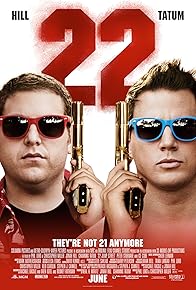
22 Jump Street (2014)
After making their way through high school (twice), big changes are in store for officers Schmidt and Jenko when they go deep undercover at a local college.
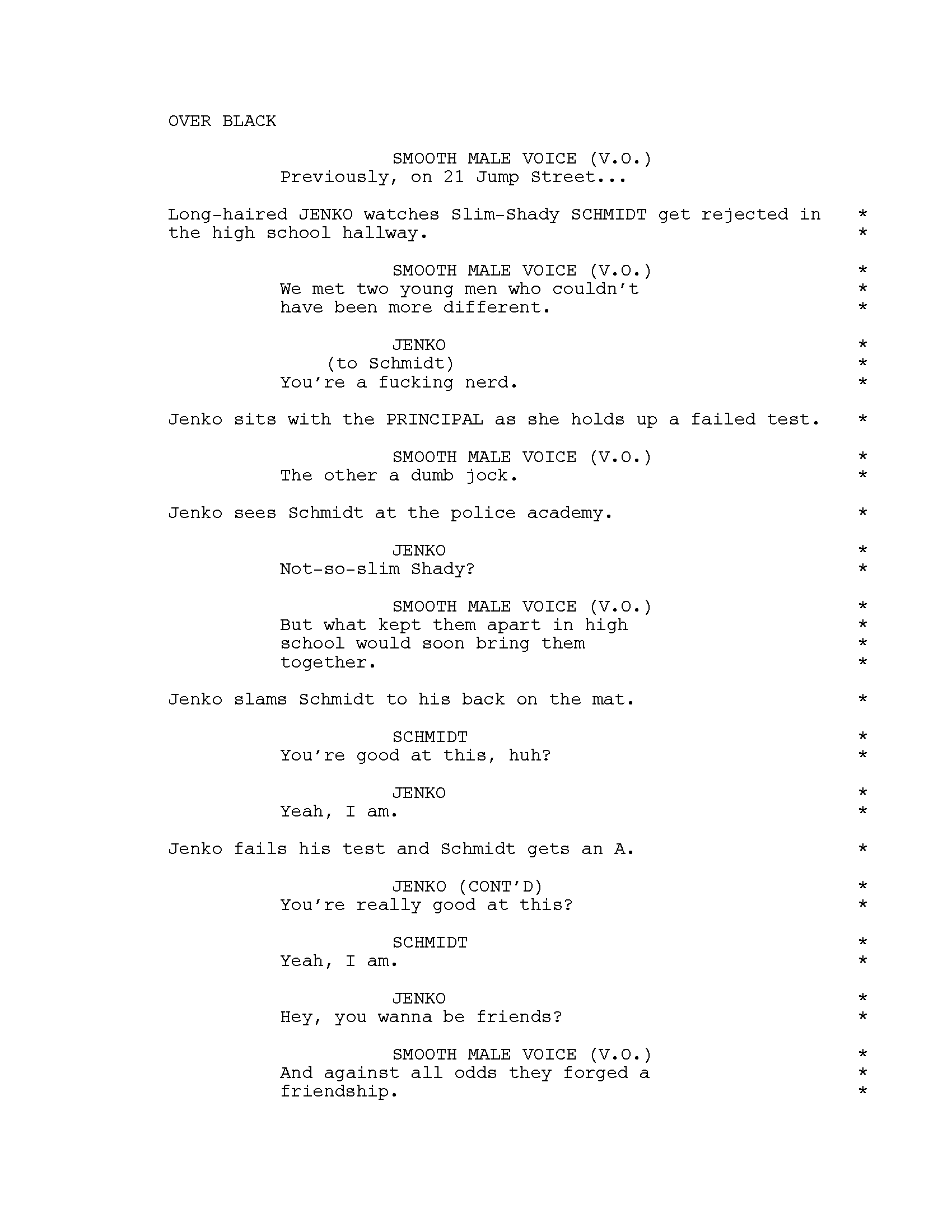
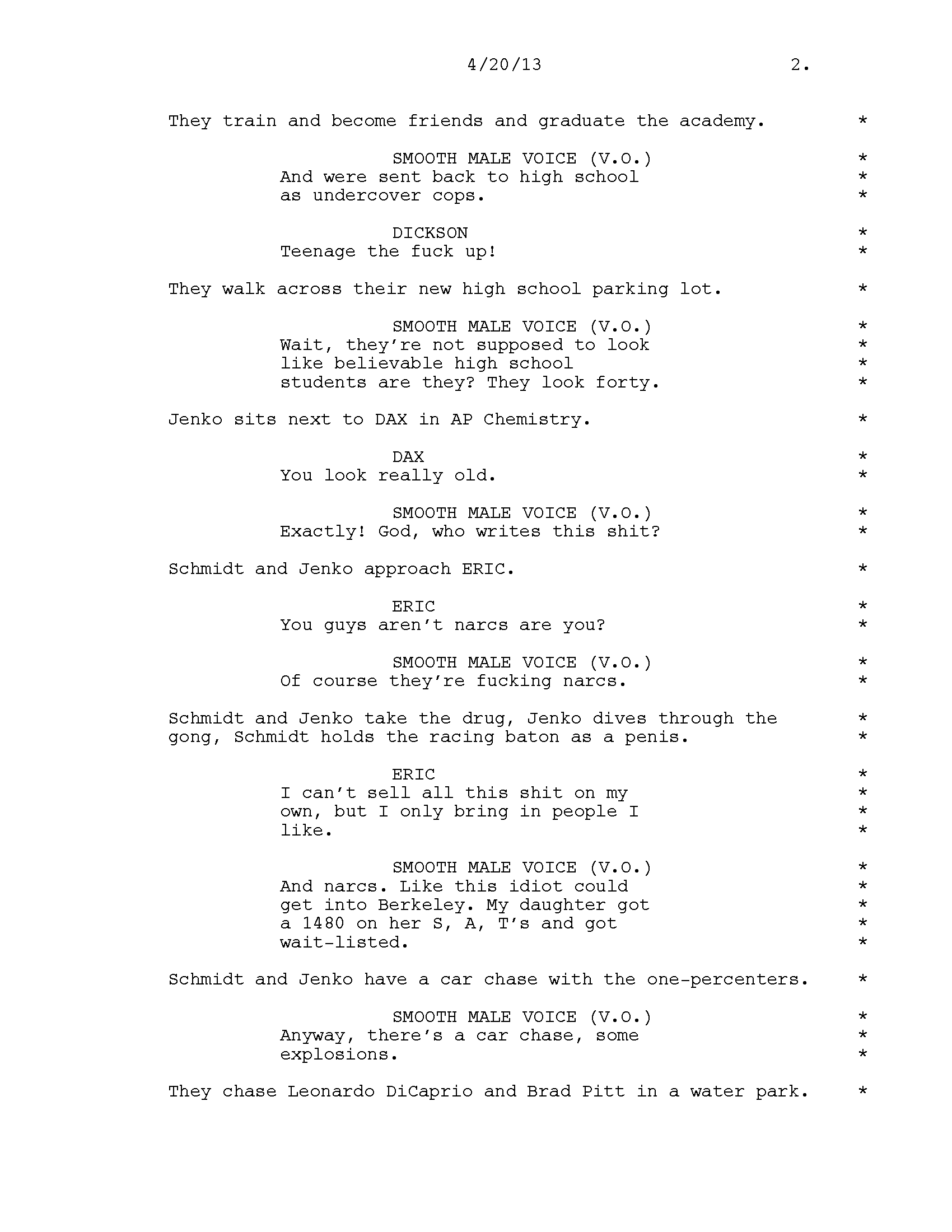
Screenplay download
Reading is open to everyone. A free account is only required to download so we can protect the library and respect rights-holder requests. Already registered? Log in and you’re set.
Read and Watch
Compare the script and movie together with 8FLiX and JustWatch.
Now that you have the screenplay, stream 22 Jump Street and compare. We've partnered with JustWatch so you can make that happen.
Looking For Something?
If you can't find what you need, send us an email.
Looking for a specific movie or TV script that isn't listed? Let us know. 8FLiX has thousands of scripts, and not all of them are indexed yet. We’re steadily adding more, but if you’d rather not wait for the catalog to catch up, send us an email. You may still have to wait, but it’ll usually be days, not geological time.