
Rustin (2023) — Read, Study & Download the Screenplay
A kinetic civil rights drama about strategy, coalition, identity, and the genius behind the march.
Rustin follows Bayard Rustin as he fights to organize the 1963 March on Washington while navigating political opposition, movement infighting, personal betrayal, and the weaponization of his sexuality. The screenplay opens against images of segregationist violence and public cruelty, then moves into the rooms where strategy is made: offices, apartments, meetings, protests, hallways, and temporary headquarters humming with impossible deadlines. Bayard is written not as a saint on a pedestal, but as a strategist, performer, lover, teacher, pacifist, troublemaker, and organizing machine with a cigarette in one hand and history in the other.
For writers and film students, this screenplay is useful because it turns political organizing into dramatic action. The work of building a march becomes suspense: numbers, permits, tents, buses, egos, alliances, betrayals, logistics, public messaging, and who gets to stand at the microphone. Study how the script makes committee rooms feel alive by giving every character a stake, every argument a tactical consequence, and every compromise a moral temperature.
Ready to get to work? Check out the Study Notes just below. When you're ready, download the Rustin screenplay.
Rustin Study Notes
What writers and film students can learn from this screenplay
Rustin is useful to study because it makes organizing feel cinematic. Bayard Rustin’s gift is not only that he can inspire a room. It is that he can turn inspiration into systems: maps, volunteers, schedules, chants, buses, coalitions, stages, sleeping arrangements, and political pressure applied with needlepoint precision. The screenplay understands that movements are not powered by speeches alone. They are built by people who argue, plan, count, call, persuade, compromise, and keep going after being insulted by allies as often as enemies. Bayard’s central conflict is brutally dramatic: the movement needs his genius, but many inside it treat his visibility as a liability.
Craft Focus
- Logistics as drama: The march is built through concrete problems: crowd size, D.C. hotels, tents, legislative pressure, police response, leadership politics, and whether the old guard will support the plan.
- Character through strategy: Bayard’s intelligence is active. He persuades, jokes, sings, provokes, corrects, charms, and organizes. His charisma is not decorative; it is how he moves the plot.
- Movement politics with stakes: The script avoids flattening civil rights leadership into a single heroic bloc. Randolph, King, Ella Baker, Roy Wilkins, Adam Clayton Powell, Medgar Evers, and the young activists all carry different pressures and fears.
- Public mission, private cost: Bayard’s sexuality is not treated as a side note. It becomes a weapon others use against him and a source of personal tension as he fights to stay useful without disappearing.
- Rooms as battlegrounds: Offices, apartments, meetings, kitchens, and conference rooms become arenas where power shifts through language, seating, silence, and who is allowed to speak.
Questions for Writers
- How does the screenplay turn planning the March on Washington into an escalating story engine?
- Where does Bayard’s humor protect him, and where does it help him seize control of a room?
- How does the script dramatize conflict within the movement without weakening the moral urgency of the cause?
- What does A. Philip Randolph provide as mentor, ally, and political shield?
- How does Bayard’s relationship with Martin Luther King Jr. shape the emotional wound beneath the public campaign?
- Where does the screenplay show that visibility can be both power and danger?
While reading, pay attention to how Rustin treats history as something assembled under pressure. The march is not inevitable because the audience knows it happened. In the script, it is fragile, absurdly ambitious, politically inconvenient, and constantly one ego, rumor, permit, or bad headline away from collapse. The craft lesson is bright as a protest button: historical drama gains urgency when the outcome feels known to us, but impossible to the people trying to make it happen.
Looking for the screenplay? Jump to the download button.
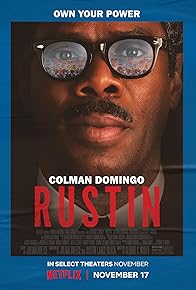
Rustin (2023)
Activist Bayard Rustin faces racism and homophobia as he helps change the course of Civil Rights history by orchestrating the 1963 March on Washington.
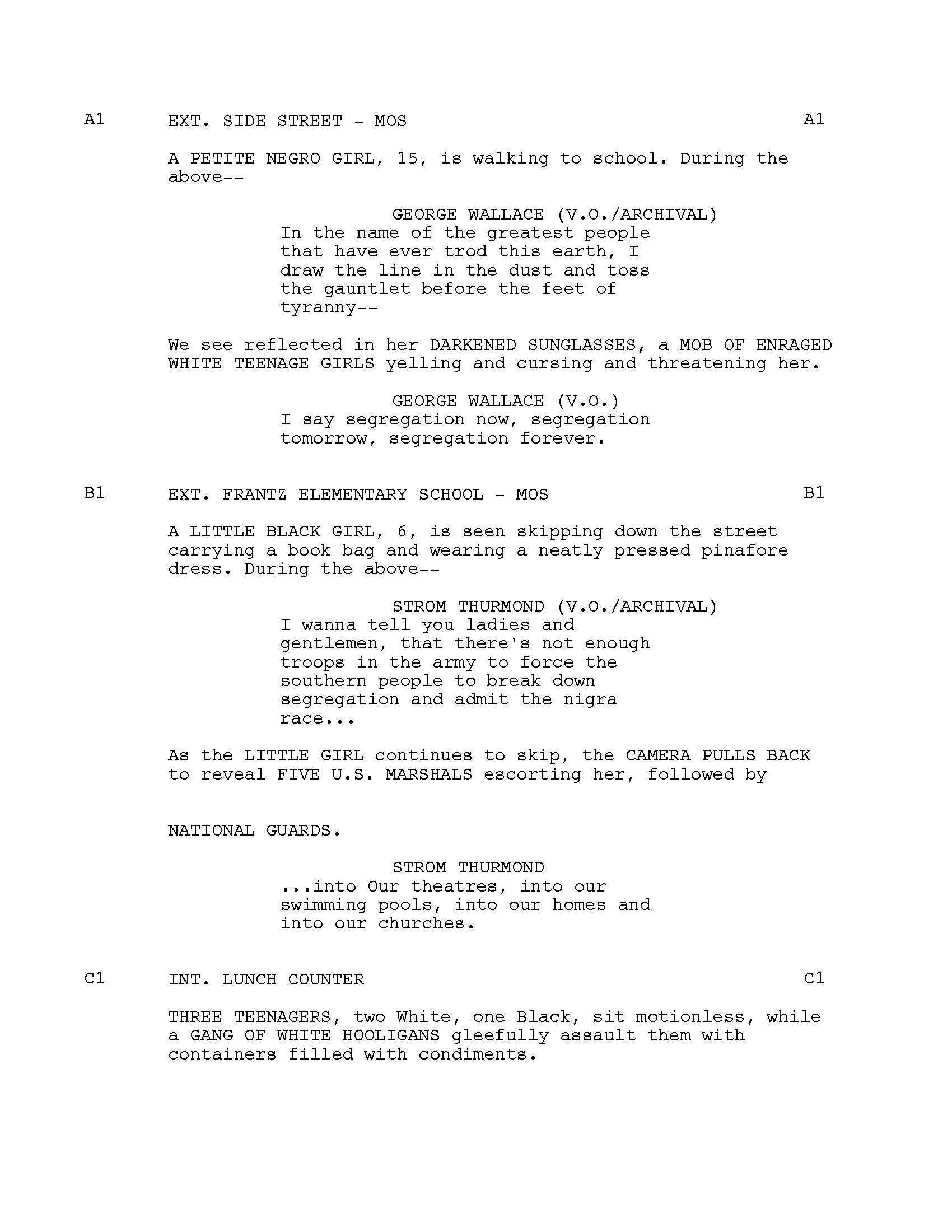
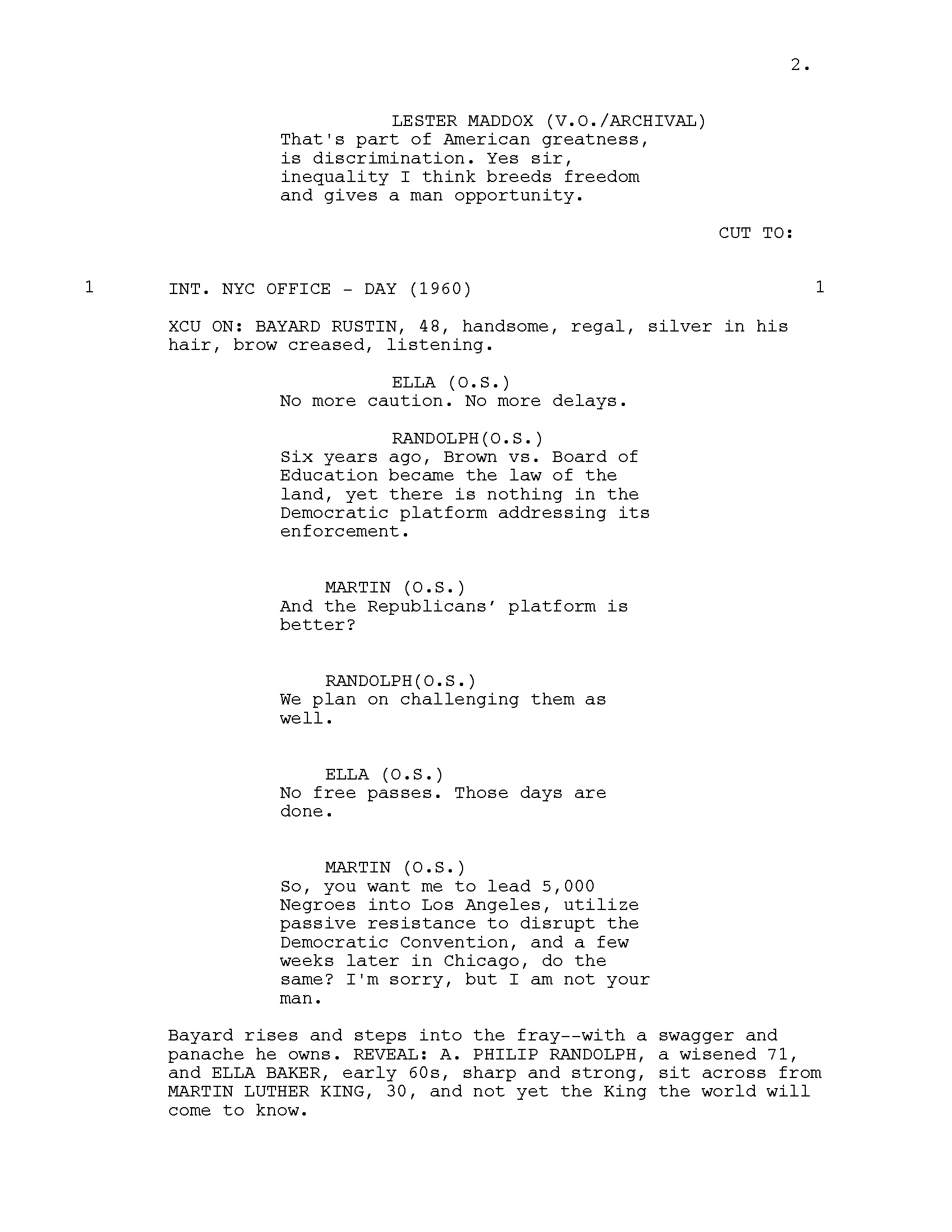
Screenplay download
Reading is open to everyone. A free account is only required to download so we can protect the library and respect rights-holder requests. Already registered? Log in and you’re set.
Read and Watch
Compare the script and movie together with 8FLiX and JustWatch.
Now that you have the screenplay, stream Rustin and compare. We've partnered with JustWatch so you can make that happen.
Looking For Something?
If you can't find what you need, send us an email.
Looking for a specific movie or TV script that isn't listed? Let us know. 8FLiX has thousands of scripts, and not all of them are indexed yet. We’re steadily adding more, but if you’d rather not wait for the catalog to catch up, send us an email. You may still have to wait, but it’ll usually be days, not geological time.

