
Guillermo del Toro's Pinocchio (2022) — Read, Study & Download the Screenplay
A dark stop-motion fairy tale about grief, fascism, imperfect sons, and a wooden boy who teaches his father how to let love change shape.
The Guillermo del Toro’s Pinocchio screenplay reimagines the classic story through loss, war, faith, and disobedience. After Geppetto loses his son Carlo during the Great War, years of grief harden around him until, in a storm of sorrow and rage, he carves a wooden boy from the pine tree that grew beside Carlo’s grave. Pinocchio comes to life not as a replacement child, but as a strange, unruly miracle in a world ruled by church judgment, fascist obedience, carnival exploitation, and the frightening possibility that love cannot be controlled.
For writers and film students, this screenplay is rich because it turns a familiar children’s fable into a story about mourning, authoritarianism, mortality, and chosen love. Study how the script uses fairy-tale logic, musical sequences, horror imagery, religious iconography, political pressure, and comic narration to deepen the emotional stakes. It is not simply about a puppet becoming a real boy. It is about a father learning that a son does not have to be perfect, obedient, or permanent to be loved.
Ready to get to work? Check out the Study Notes just below. When you're ready, download the Guillermo del Toro's Pinocchio screenplay.
Guillermo del Toro’s Pinocchio Study Notes
What writers and film students can learn from this screenplay
Guillermo del Toro’s Pinocchio is useful to study because it rebuilds a famous fable around grief instead of moral obedience. The screenplay begins with Geppetto mourning Carlo, the son he lost during the Great War, then lets that loss grow into the literal wood of the story: a pine cone, a grave, a tree, a drunken act of carving, and a boy who arrives as both miracle and wound. Pinocchio is not written as a clean substitute for Carlo. He is noisy, curious, breakable, indestructible, disobedient, and alive in a way Geppetto does not know how to accept. Around them, the world demands control: the church wants order, the Podestà wants obedience, Count Volpe wants profit, and fascism wants boys turned into weapons. The script’s deepest movement is emotional, not magical. It asks Geppetto to stop loving an idea of a perfect son and learn to love the imperfect one standing in front of him.
Craft Focus
- Adaptation with a thesis: The screenplay does not merely retell Pinocchio. It argues with it, shifting the lesson from “be obedient” to “learn how to love, choose, and sacrifice.”
- Grief as origin story: Carlo’s death gives the fantasy a tragic root. Pinocchio is born from mourning, rage, alcohol, prayer, wood, and impossible longing.
- Fairy tale against fascism: The world around Pinocchio keeps repeating the logic of command: believe, obey, fight. His refusal to behave becomes moral resistance, not childish failure.
- Comic narration with darkness underneath: Sebastian J. Cricket gives the story wit, rhythm, and self-importance, but his comic perspective also helps the script move through death, fear, and sorrow without becoming airless.
- Mortality as transformation: Pinocchio’s gift is not that he can avoid death forever. The story matures when he understands that love matters because time runs out.
Questions for Writers
- How does the opening with Carlo change the audience’s expectations for a familiar Pinocchio story?
- Why is it important that Pinocchio is carved in grief and anger rather than gentle wish fulfillment?
- How does the screenplay use the unfinished crucifix to connect faith, art, community judgment, and Geppetto’s frozen mourning?
- Where does Pinocchio’s disobedience become a virtue instead of a flaw?
- How do Count Volpe, the Podestà, and the Town Priest each represent a different system trying to define what Pinocchio is?
- Why does the ending depend on Geppetto accepting Pinocchio as himself, rather than as Carlo restored?
While reading, pay attention to how Guillermo del Toro’s Pinocchio treats imperfection as sacred. Carlo is remembered as perfect because he is gone. Pinocchio is present, chaotic, unfinished, strange, and impossible to control. That contrast is the craft engine humming inside the puppet chest. The screenplay’s great lesson is not that the wooden boy must become normal. It is that the adults must become brave enough to love what is alive instead of worshipping what cannot return.
Looking for the screenplay? Jump to the download button.
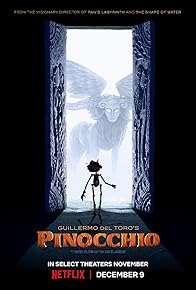
Guillermo del Toro's Pinocchio (2022)
A father's wish magically brings a wooden boy to life in Italy, giving him a chance to care for the child.
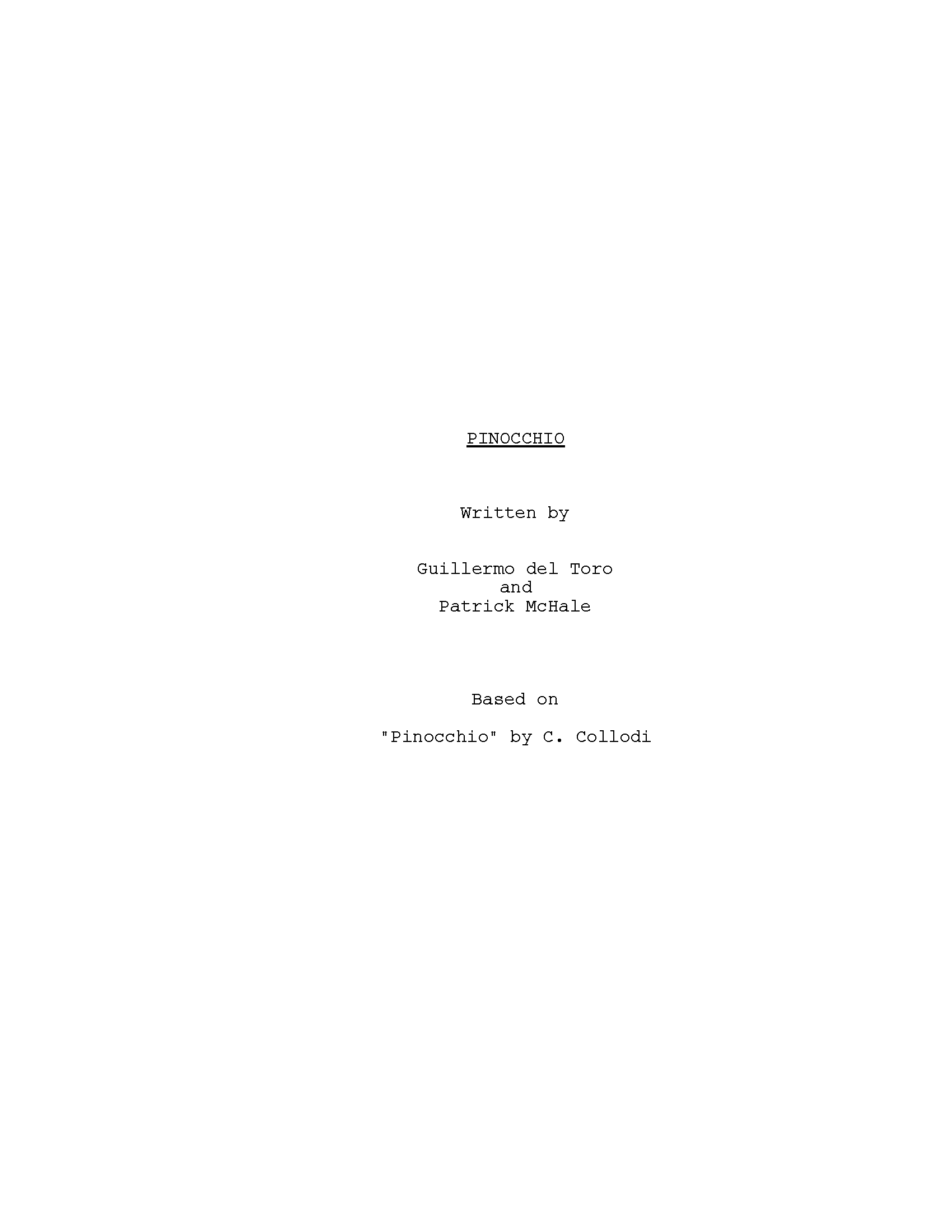
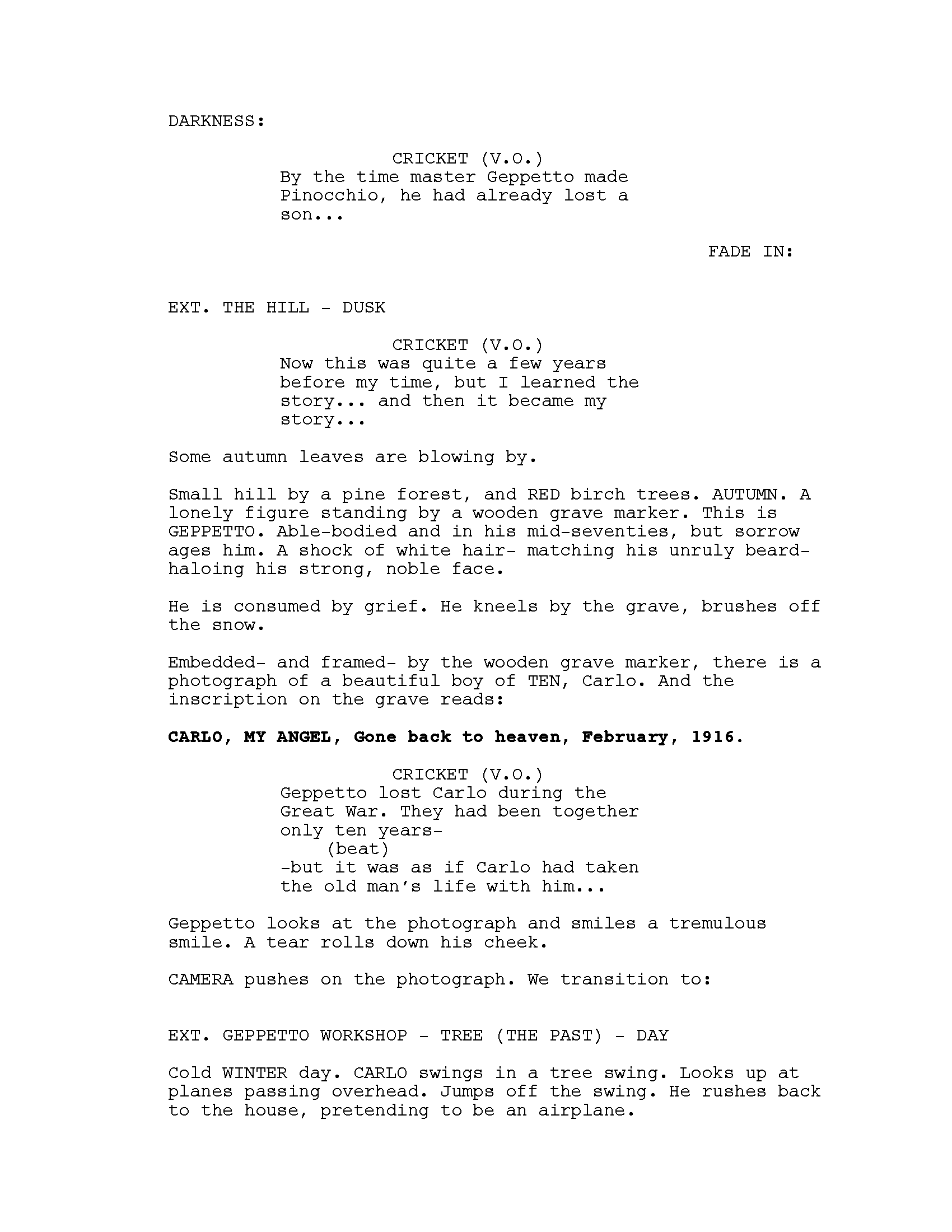
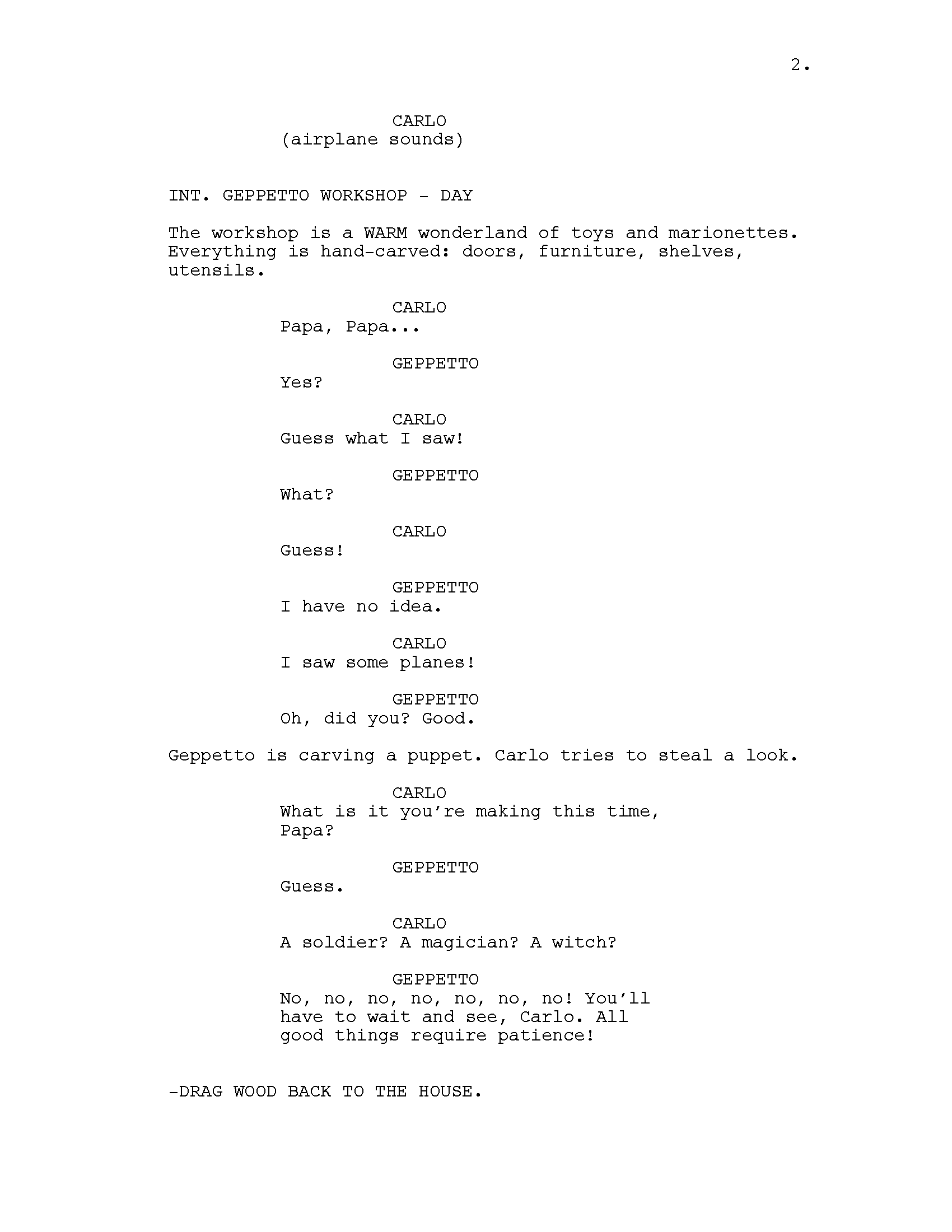
Screenplay download
Reading is open to everyone. A free account is only required to download so we can protect the library and respect rights-holder requests. Already registered? Log in and you’re set.
Read and Watch
Compare the script and movie together with 8FLiX and JustWatch.
Now that you have the screenplay, stream Guillermo del Toro's Pinocchio and compare. We've partnered with JustWatch so you can make that happen.
Looking For Something?
If you can't find what you need, send us an email.
Looking for a specific movie or TV script that isn't listed? Let us know. 8FLiX has thousands of scripts, and not all of them are indexed yet. We’re steadily adding more, but if you’d rather not wait for the catalog to catch up, send us an email. You may still have to wait, but it’ll usually be days, not geological time.

