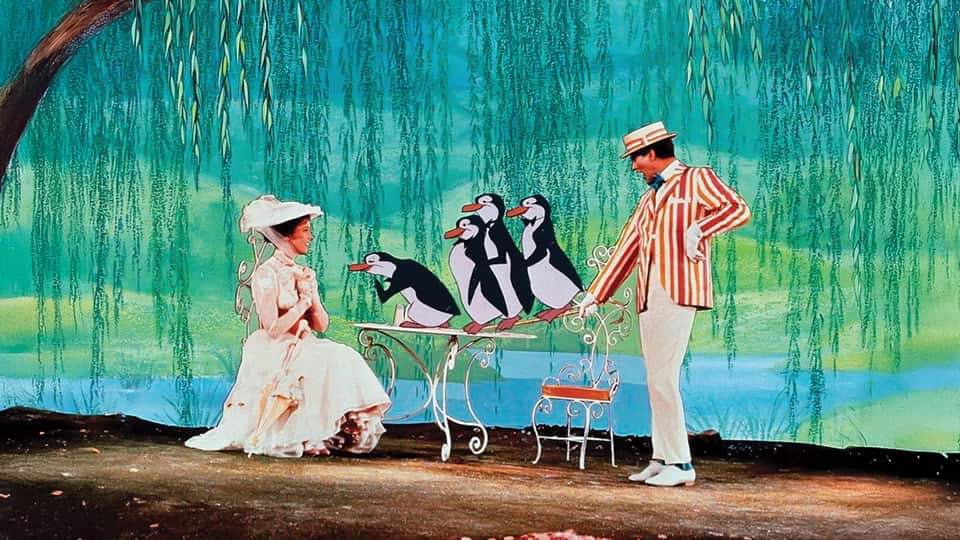
Mary Poppins (1964) — Read, Study & Download the Screenplay
A musical fantasy about childhood, order, wonder, family repair, and a magical nanny who fixes the father as much as the children.
The Mary Poppins screenplay follows the Banks family at Number 17 Cherry Tree Lane, where Jane and Michael keep escaping their nannies, Mrs. Banks is swept up in the suffragette movement, and Mr. Banks believes a proper household should run like a bank ledger. When Mary Poppins arrives on the east wind, she brings discipline, mystery, songs, impossible outings, and just enough enchantment to show the family what has been missing inside their carefully managed home.
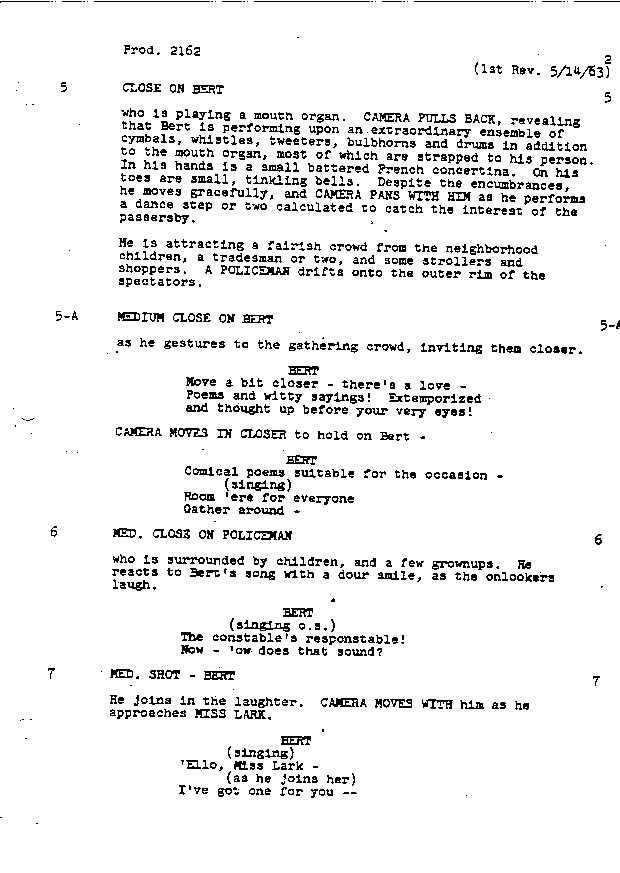
For writers and film students, this screenplay is useful because it shows how a musical fantasy can build emotional change through episodic structure. Study how the script moves from Bert’s direct address and street performance to the Banks household crisis, the magical nursery, chalk-picture adventure, Uncle Albert, the bank sequence, “Feed the Birds,” rooftop chimney-sweep spectacle, and the final kite scene. It is a family musical where every number, joke, and impossible object quietly asks the same question: what does it cost a parent to forget wonder?
Ready to get to work? Check out the Study Notes just below. When you're ready, download the Mary Poppins screenplay.
Mary Poppins Study Notes
What writers and film students can learn from this screenplay
The Mary Poppins screenplay is useful to study because it shows how a seemingly episodic musical can still carry a precise emotional arc. The shooting script by Bill Walsh and Don DaGradi, with songs by Richard M. Sherman and Robert B. Sherman, begins by giving Bert the role of guide, performer, commentator, and friendly conspirator. From there, the story enters Number 17 Cherry Tree Lane, where the children’s misbehavior is not the real illness. The household is out of tune. Mrs. Banks is pulled toward public reform, Mr. Banks worships order and finance, and Jane and Michael are desperate for attention that feels alive. Mary Poppins arrives like weather with a hatpin, and every magical episode tests the family’s imagination, discipline, and capacity for joy.
Craft Focus
- Episodic structure with a hidden spine: The chalk pavement, nursery magic, Uncle Albert, bank trip, rooftop sequence, and kite ending feel like separate adventures, but each one pressures the Banks family’s emotional disorder.
- Mary as catalytic mystery: Mary Poppins rarely explains herself. She enters, rearranges behavior, denies the impossible, and leaves others changed without making the story about her personal transformation.
- Musical numbers as argument: The songs do not simply decorate the plot. They express competing worldviews: discipline, wonder, charity, labor, play, social order, and emotional release.
- Parent arc beneath child fantasy: Jane and Michael begin as the apparent problem, but the deeper dramatic movement belongs to Mr. Banks, whose certainty must collapse before the family can heal.
- Bert as bridge character: Bert moves between street, fantasy, labor, performance, and moral commentary. He keeps the audience oriented while letting the film’s tone dance from comedy to wonder to melancholy.
Questions for Writers
- How does Bert’s opening direct address prepare the audience to accept a story where theatricality and reality constantly shake hands?
- Why does the script introduce the household through noise, disorder, and missing children before Mary Poppins appears?
- How does Mr. Banks’ song about order and authority reveal his flaw more efficiently than a conventional speech would?
- Where do the magical set pieces function as emotional lessons rather than random spectacle?
- How does “Feed the Birds” shift the movie from comic fantasy into moral feeling?
- Why does the final kite scene resolve the family story better than a simple apology scene would?
While reading, pay attention to how Mary Poppins keeps its magic attached to behavior. The carpetbag, chalk drawings, floating laughter, chimney-sweep dance, bird woman, and flying kite all charm the eye, but the craft lives underneath: each impossible event reveals something practical about attention, generosity, imagination, or control. The lesson is sugar-dusted but sturdy: fantasy works best when the spectacle repairs something human. Mary Poppins does not arrive to make life easy. She arrives to make the Banks family see what their own house has been trying to tell them.
Looking for the screenplay? Jump to the download button.
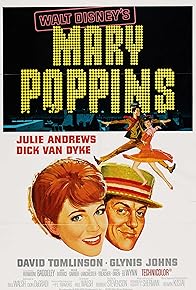
Mary Poppins (1964)
In turn of the century London, a magical nanny employs music and adventure to help two neglected children become closer to their father.
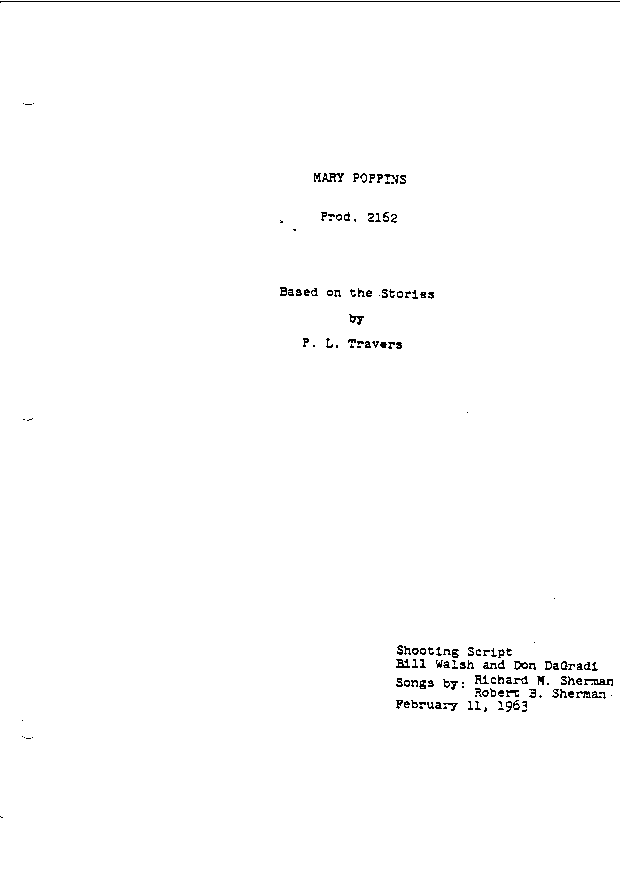
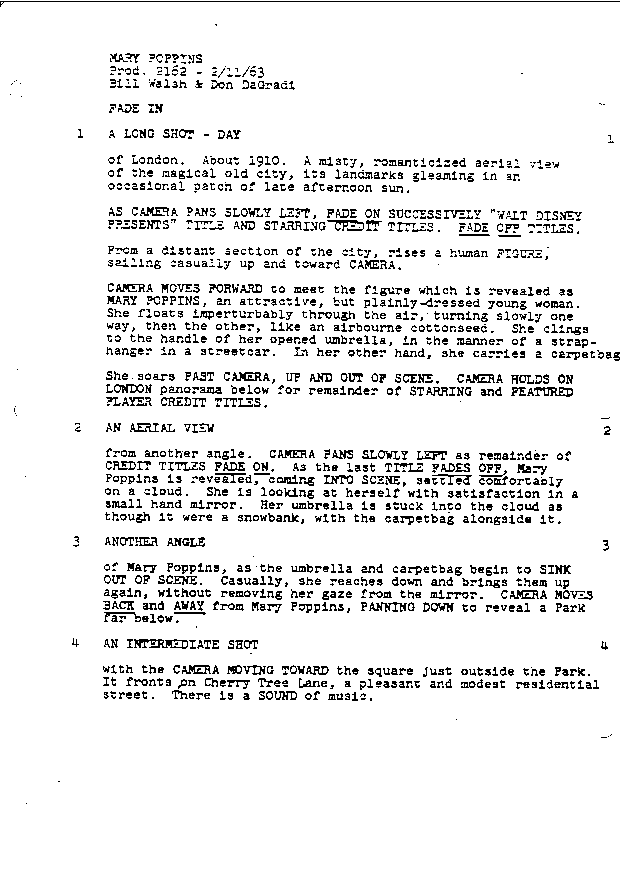
Screenplay download
Reading is open to everyone. A free account is only required to download so we can protect the library and respect rights-holder requests. Already registered? Log in and you’re set.
Read and Watch
Compare the script and movie together with 8FLiX and JustWatch.
Now that you have the screenplay, stream Mary Poppins and compare. We've partnered with JustWatch so you can make that happen.
Looking For Something?
If you can't find what you need, send us an email.
Looking for a specific movie or TV script that isn't listed? Let us know. 8FLiX has thousands of scripts, and not all of them are indexed yet. We’re steadily adding more, but if you’d rather not wait for the catalog to catch up, send us an email. You may still have to wait, but it’ll usually be days, not geological time.