Inglourious Basterds (2009) — Read, Study & Download the Screenplay
A revisionist World War II thriller about language, performance, revenge, and cinema itself becoming the weapon that rewrites history.
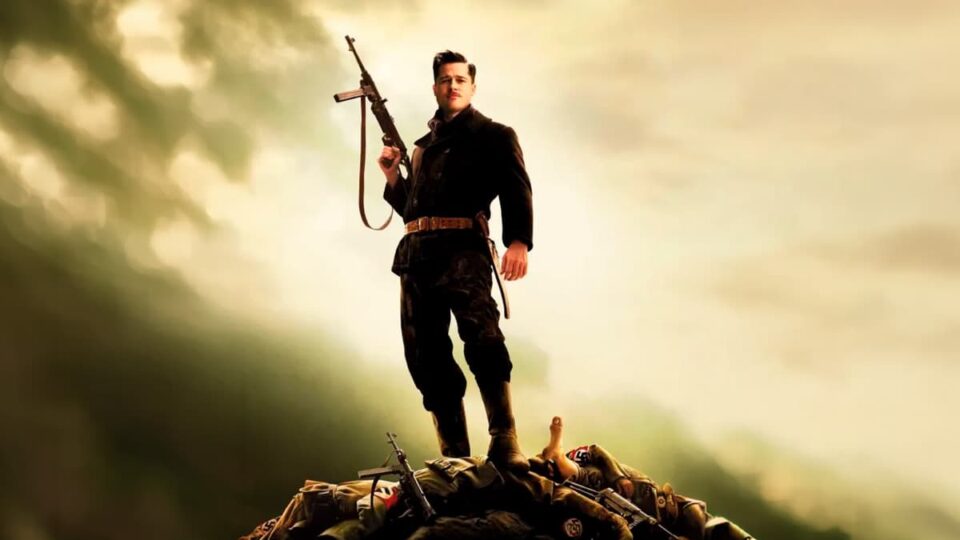
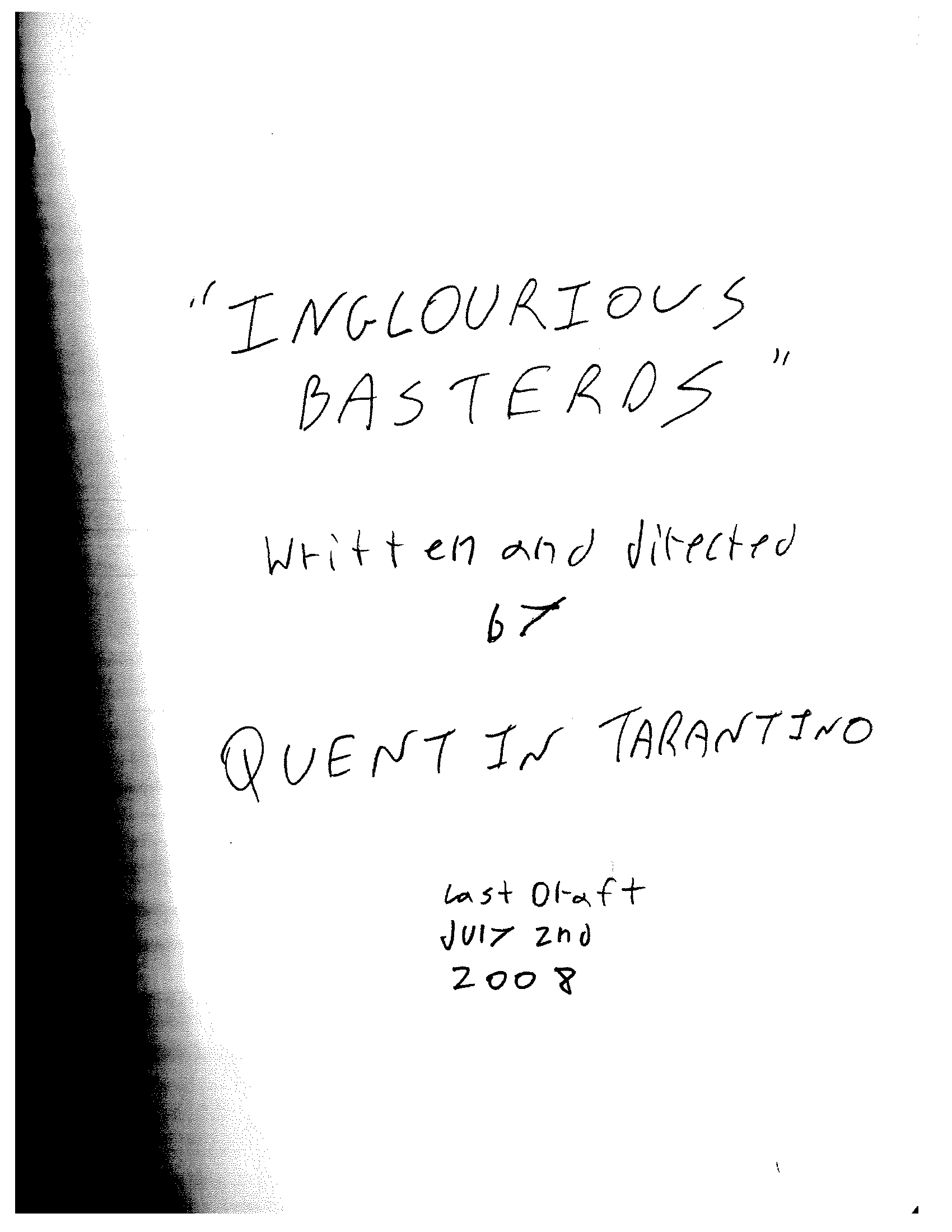
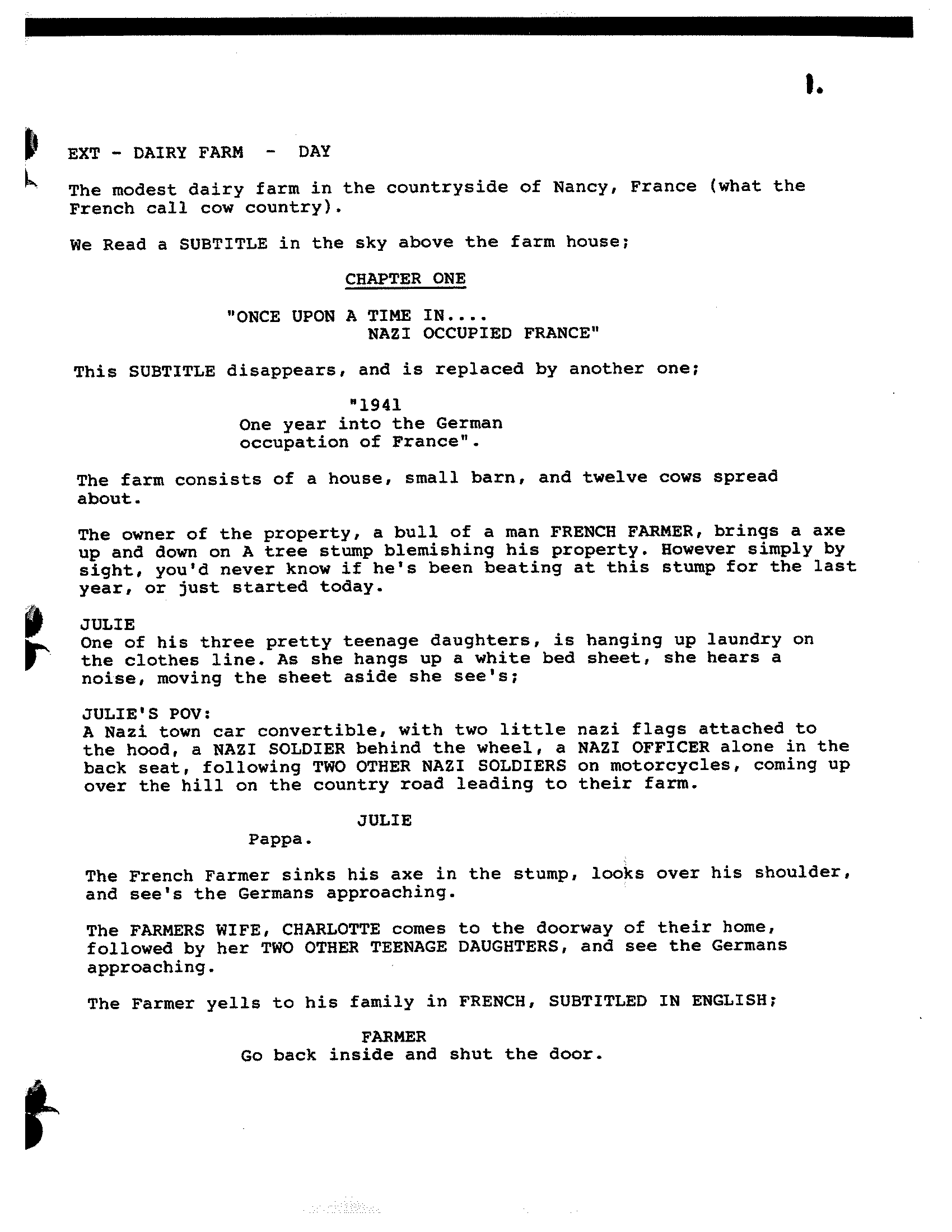
The Inglourious Basterds screenplay unfolds across five chaptered movements in Nazi-occupied France, beginning with one of modern screenwriting’s great suspense sequences: Colonel Hans Landa interrogating dairy farmer Perrier LaPadite while the Jewish Dreyfus family hides beneath the floorboards. Years later, survivor Shosanna Dreyfus runs a Paris cinema under a new identity, while Lt. Aldo Raine leads a squad of Jewish-American soldiers on a brutal campaign behind enemy lines. Their paths converge around a German propaganda premiere that places Hitler, Goebbels, Landa, the Basterds, and Shosanna’s revenge plan inside the same theater.
For writers and film students, Tarantino’s last draft is essential because it treats dialogue as suspense, performance as survival, and film history as something that can be hijacked from inside the projector booth. Study how the screenplay uses chapter cards, multilingual conversations, false identities, theatrical violence, delayed reveals, and controlled point of view to build tension before a gun is drawn. This is not a conventional war movie. It is a revenge fable about masks, accents, cinema, and the terrifying power of knowing exactly which story your enemy thinks he is in.
Ready to get to work? Check out the Study Notes just below. When you're ready, download the Inglourious Basterds (2009) screenplay.
Inglourious Basterds Study Notes
What writers and film students can learn from this screenplay
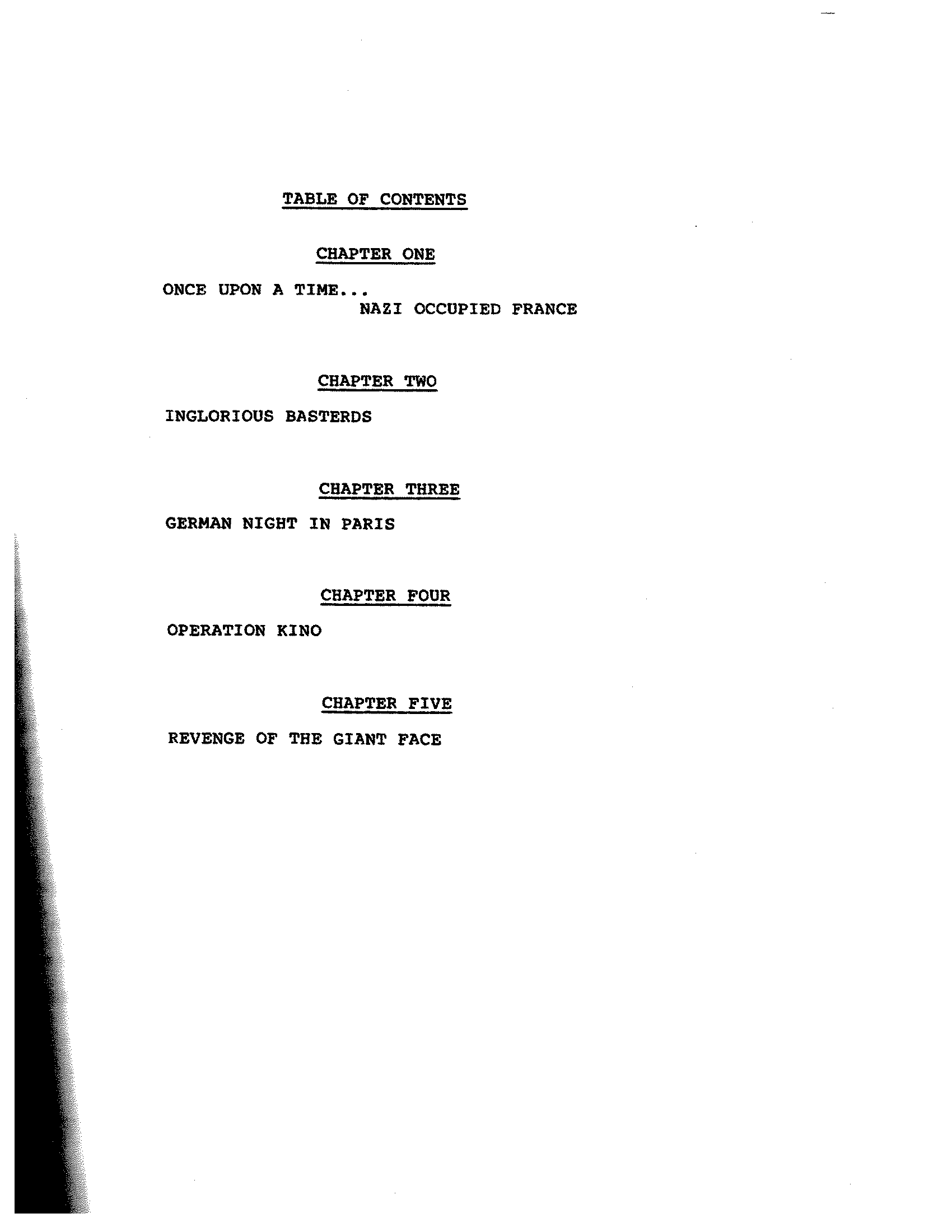
This Inglourious Basterds screenplay is useful to study because it turns suspense into a matter of language, manners, and performance. Quentin Tarantino’s last draft is organized as five chapters, each with its own pressure system: the farmhouse interrogation in Nazi-occupied France, Aldo Raine’s introduction of the Basterds, Shosanna’s life in Paris, Operation Kino, and the final revenge at the cinema. The opening chapter is a masterclass in controlled dread. Landa does not begin with violence. He begins with courtesy, milk, questions, charm, pauses, and the terrible patience of a man who already suspects the answer. That pattern repeats throughout the script. Characters survive by performing: Shosanna performs as Emmanuelle Mimieux, Hicox performs as a German officer, Bridget von Hammersmark performs loyalty and glamour, Aldo performs exaggerated hill-country menace, and Landa performs civilization while hunting people with surgical amusement. The screenplay’s genius is that every conversation feels like a duel where grammar, accent, gesture, silence, and timing can kill. By the climax, the movie theater becomes the perfect battlefield: cinema, propaganda, revenge, spectatorship, and history all locked in one flammable room.
Craft Focus
- Chaptered architecture: The screenplay uses five titled chapters to give the story a novelistic rhythm while still building toward a single explosive convergence.
- Dialogue as action: Long conversations are structured like set pieces. The suspense comes from what characters know, what they suspect, and what they are forced to conceal.
- Performance under threat: Nearly every major character survives by playing a role. The script turns acting, code-switching, accent, and identity into life-or-death mechanics.
- Villain as conversational predator: Hans Landa’s menace comes from attention. He listens, flatters, changes language, studies discomfort, and weaponizes politeness.
- Parallel revenge engines: Aldo’s Basterds and Shosanna’s cinema plot run separately for much of the script, then collide inside the premiere of Nation’s Pride.
- Cinema as weapon: Film is not just a setting or theme. Projectors, nitrate prints, propaganda reels, close-ups, spectacle, and audience manipulation become instruments of revenge.
Questions for Writers
- How does the farmhouse opening create unbearable tension before any overt violence occurs?
- Why does Landa’s politeness make him more frightening than immediate aggression would?
- How does the script use language changes, especially French, English, and German, to shift power inside scenes?
- What does Shosanna gain as a protagonist by being patient, strategic, and visually composed?
- How does Aldo Raine’s blunt theatricality contrast with Landa’s refined theatricality?
- Why does the tavern sequence work as a suspense scene built almost entirely from behavior, cover stories, and small mistakes?
- How does the climax make cinema both the method of revenge and the subject of the revenge?
While reading, pay attention to how Inglourious Basterds makes knowledge uneven. Someone always knows more than someone else: Landa knows what LaPadite is hiding, Shosanna knows who Landa is, Hicox knows film history but not enough tavern culture, Bridget knows the mission’s stakes, Aldo knows violence better than etiquette, and the audience often knows the trap before the character can escape it. That is the craft lesson beneath the chapter cards and cigarette smoke: suspense does not require constant motion. Sometimes it only requires a table, a glass of milk, a false name, and one person politely asking the question everyone fears.
Looking for the screenplay? Jump to the download button.
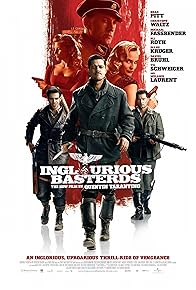
Inglourious Basterds (2009)
In Nazi-occupied France during World War II, a plan to assassinate Nazi leaders by a group of Jewish U.S. soldiers coincides with a theatre owner's vengeful plans for the same.
Screenplay download
Reading is open to everyone. A free account is only required to download so we can protect the library and respect rights-holder requests. Already registered? Log in and you’re set.
Read and Watch
Compare the script and movie together with 8FLiX and JustWatch.
Now that you have the screenplay, stream Inglourious Basterds and compare. We've partnered with JustWatch so you can make that happen.
Looking For Something?
If you can't find what you need, send us an email.
Looking for a specific movie or TV script that isn't listed? Let us know. 8FLiX has thousands of scripts, and not all of them are indexed yet. We’re steadily adding more, but if you’d rather not wait for the catalog to catch up, send us an email. You may still have to wait, but it’ll usually be days, not geological time.