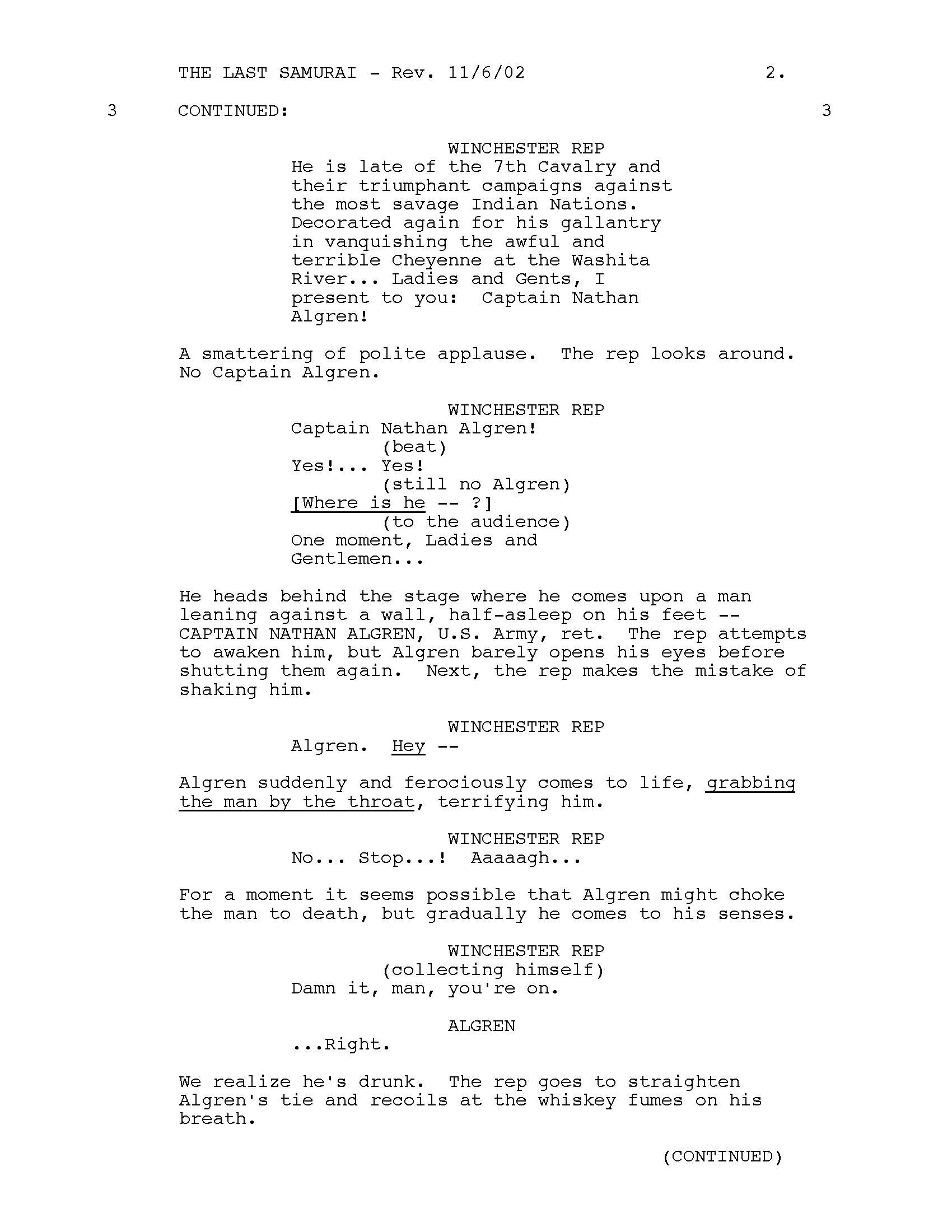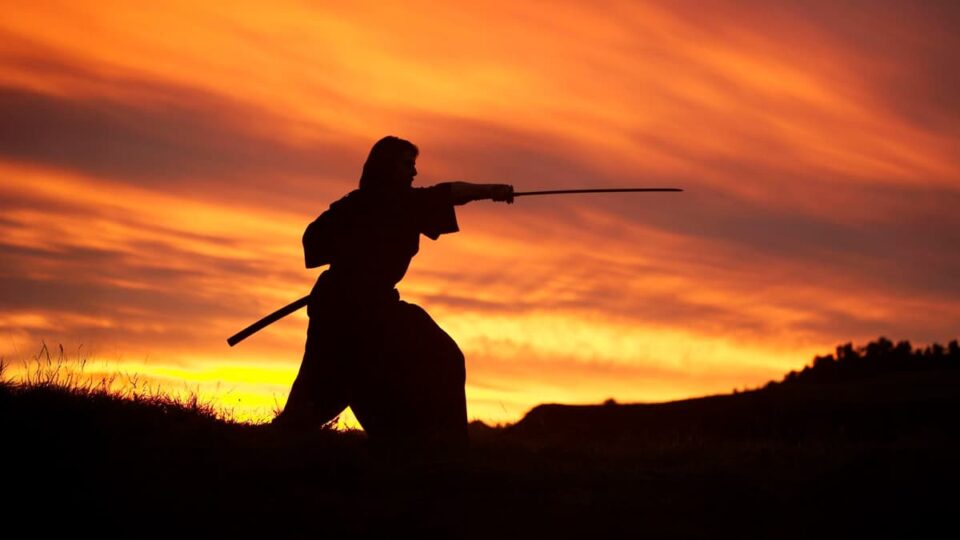
The Last Samurai screenplay - read and download for free on 8FLiX
Home / Scripts / Film / The Last Samurai (2003) Screenplay

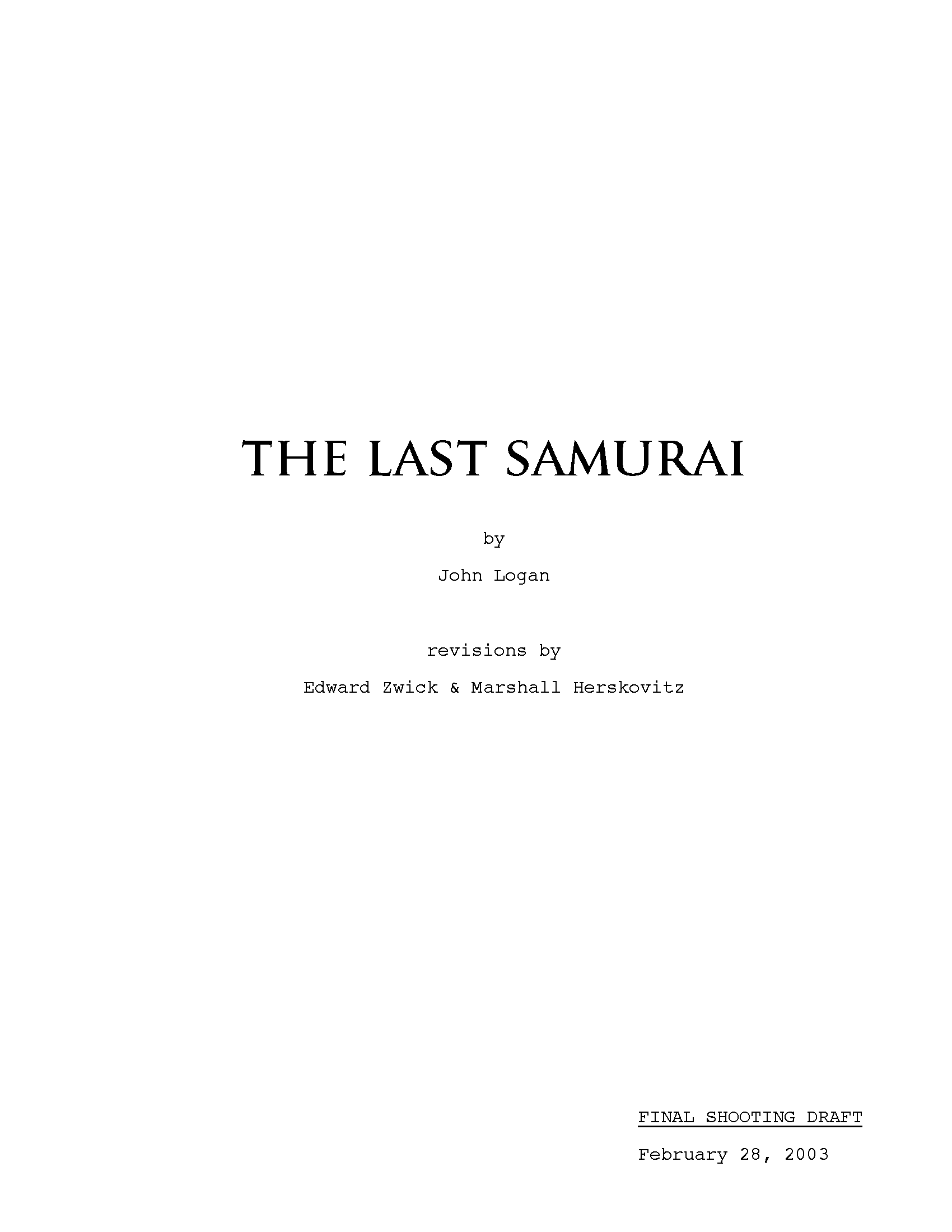
The Last Samurai (2003) Screenplay

The Last Samurai (2003) — Read, Study & Download the Screenplay

An epic historical drama about shame, discipline, cultural collision, and a broken soldier finding a code strong enough to hold him together.

The Last Samurai screenplay follows Captain Nathan Algren, a disgraced former U.S. Cavalry officer haunted by the violence he helped carry out in the American West. Hired to train Japan’s new Imperial Army, Algren arrives in a country being rapidly pulled toward railroads, rifles, trade agreements, and Western military power. But after an early battle ends in catastrophe, he is taken prisoner by Katsumoto, a samurai lord resisting the forces that would erase his way of life.

For writers and film students, this final shooting draft is useful because it builds an epic around observation, shame, and transformation rather than simple victory. Study how the screenplay contrasts spectacle with stillness: Winchester salesmanship against battlefield trauma, Tokyo modernization against the mountain village, rifle volleys against sword discipline, and Algren’s self-loathing against Katsumoto’s ritual clarity. The story’s richest craft question is not whether Algren can become a warrior. It is whether a man shaped by violence can learn to see beauty, duty, and death without lying to himself.
8FLiX Study Notes
Screenplay craft notes · Historical Epic/War Drama · February 28, 2003 final shooting draft · No companion PDF
Written by Nick Runyeard

The Last Samurai Study Notes

What writers and film students can learn from this screenplay

The Last Samurai is useful to study because it builds a historical epic around a damaged witness. John Logan’s final shooting draft introduces Nathan Algren not as a noble hero, but as a man being sold by the machinery of empire. He is drunk, traumatized, and reduced to performing battlefield legend for the Winchester Company, a commercial spectacle that turns war guilt into rifle advertising. That opening gives the screenplay its central wound. Algren has survived violence, profited from it, helped explain it, and cannot forgive himself for what he knows. Japan becomes the mirror that forces him to look again. In Tokyo, modernization is shown as dazzling, chaotic, ambitious, and transactional: railroads, rifles, foreign advisors, diplomats, trade deals, new uniforms, and an army still learning how to stand in line. Katsumoto’s mountain village offers the opposite dramatic rhythm: silence, ritual, weather, discipline, family, craft, and a warrior code built around attention. The script’s craft engine is contrast. Algren is trained to kill efficiently. Katsumoto is trained to live deliberately. Between them, the story studies whether honor can survive modernization, whether tradition can survive politics, and whether a man ruined by one empire can recognize the birth pains of another.

Craft Focus

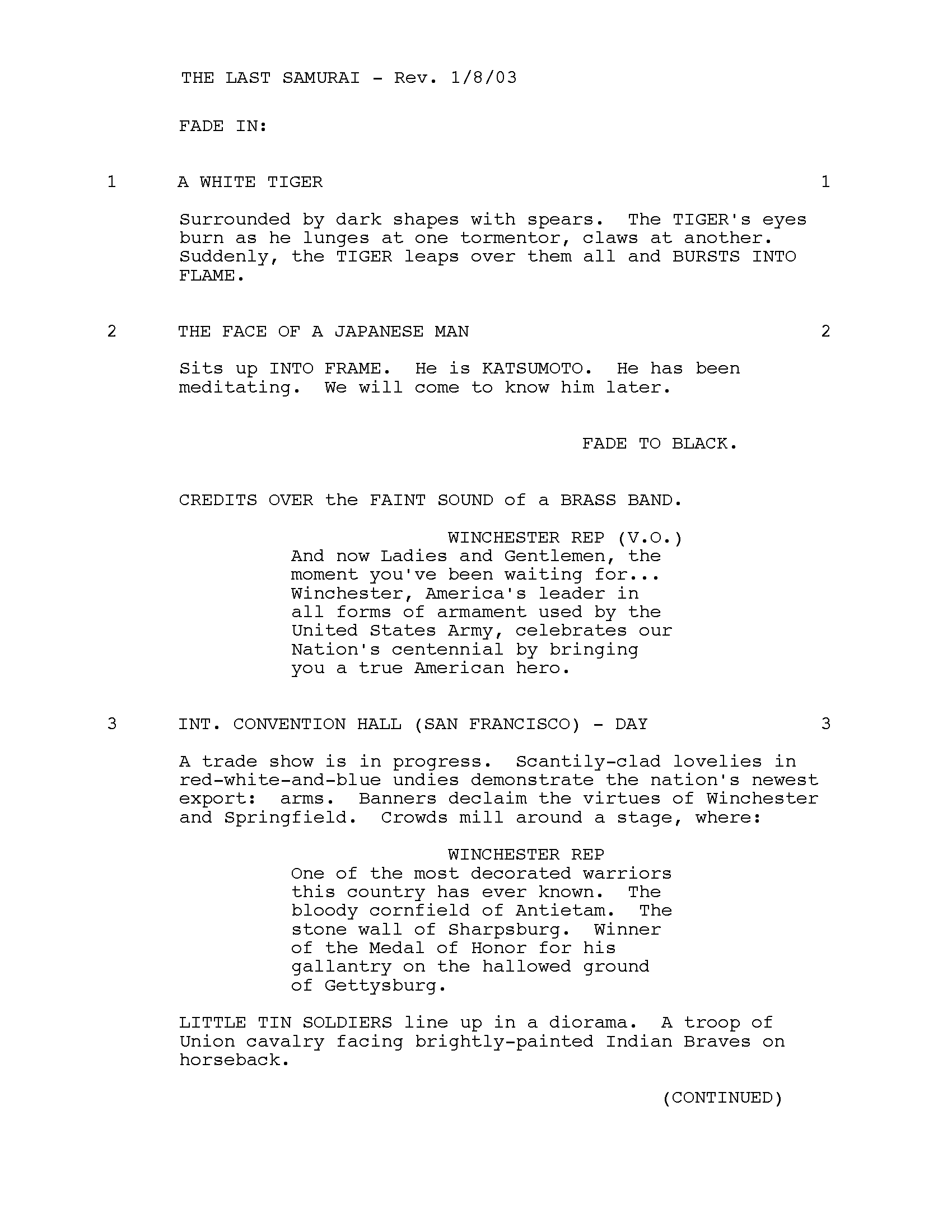
  • Trauma as introduction: Algren’s Winchester presentation turns exposition into breakdown, revealing his history, guilt, alcoholism, combat instincts, and disgust with commercialized violence.
  • Culture clash through design: The screenplay contrasts trade shows, hotels, rifles, restaurants, trains, and diplomatic rooms with village porches, armor, rain, calligraphy, sword practice, and seasonal change.
  • Mentor-antagonist reversal: Katsumoto begins as Algren’s enemy, then becomes the person who understands his wound most clearly. Their relationship develops through study, captivity, debate, and mutual recognition.
  • Outsider point of view: Algren gives the audience an entry into the samurai world, but the screenplay also makes his limitations visible: he arrives ignorant, racist, drunk, and morally compromised.
  • Action with philosophical stakes: The forest ambush, Tokyo rescue, village preparations, and final battle are not only combat sequences. Each asks what kind of war is being fought, and what kind of death the characters believe is meaningful.
  • Modernity as antagonist and necessity: Omura’s world is exploitative and self-interested, but the screenplay avoids making change itself simple. The Emperor’s final choice reframes modernization as something Japan must define for itself.

Questions for Writers

  • How does the white tiger dream at the beginning prepare the audience for Katsumoto’s later reading of Algren?
  • Why is Algren introduced selling rifles instead of fighting in battle?
  • How does the screenplay use Bagley to connect Algren’s American past to Japan’s present conflict?
  • Where does Graham function as translator, commentator, comic relief, and historical frame all at once?
  • How does the fog-bound first battle make the samurai feel both terrifying and mythic?
  • Why does the village section slow the plot down, and how does that slowness become the point?
  • How does the final meeting with the Emperor shift the story from personal redemption to national identity?

While reading, pay attention to how The Last Samurai uses stillness as a dramatic weapon. The loudest worlds in the script are often the most spiritually empty: the Winchester stage, the diplomatic rooms, the parade ground, the machinery of Omura’s modernization. The quietest scenes often carry the deepest change: Algren watching Taka’s household, learning the sword, writing in his journal, sitting with Katsumoto, or noticing the shape of a perfect blossom before it falls. That is the craft lesson beneath the armor and gun smoke: epics do not become large only by adding armies. They become large when the private transformation of one damaged soul is made to rhyme with the transformation of an entire country.

Looking for the screenplay? Jump to the download button.

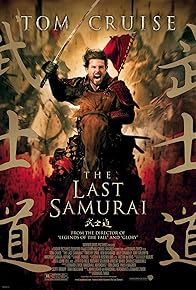
The Last Samurai (2003) poster

The Last Samurai (2003)

One Sheet & Script Intel

In 19th century Japan, Nathan Algren, a US army captain, is hired by the Japanese emperor to train his army in the modern warfare techniques. Captain Algren finds himself trapped in a struggle between two eras and two worlds.
— Warner Bros.
Source
ORIGINAL
Version
RevisedFINAL
Date
02.28.2003
Pages
128
IMDb ID

Screenplay download

Download The Last Samurai (2003) screenplay and study it for screenwriting analysis, research, and educational use.

Reading is open to everyone. A free account is only required to download so we can protect the library and respect rights-holder requests. Already registered? Log in and you’re set.


Read and Watch

Compare the script and movie together with 8FLiX and JustWatch.

Now that you have the screenplay, stream The Last Samurai and compare. We've partnered with JustWatch so you can make that happen.

Looking For Something?

If you can't find what you need, send us an email.

Looking for a specific movie or TV script that isn't listed? Let us know. 8FLiX has thousands of scripts, and not all of them are indexed yet. We’re steadily adding more, but if you’d rather not wait for the catalog to catch up, send us an email. You may still have to wait, but it’ll usually be days, not geological time.